Showing posts with label Thanksgiving pilgrims. Show all posts

Sunday, November 23, 2025

Those Naughty Pilgrims

With Thanksgiving comes stories of the Pilgrims taking up residence in the new world, landing at Plymouth Rock in what is now the state of Massachusetts.  The pious Pilgrims certainly have a reputation for being a rigid, hard-working, and humorless group.  But there are a few surprises to be found.  Even though drunkenness was discouraged, beer was accepted as a drink for men, women, and even children.  The daily ration on the Mayflower was a gallon a day for each individual.  It took 66 days for them to sail from England to their landing place of Plymouth Rock.  Hmmm…66 days times 1 gallon per person times the number of people on the ship.  It seems that a lot of room on board the ship was devoted to storing the beer ration.

Even sex was not taboo under the right circumstances.  They had a matter-of-fact attitude about sex as long as it was between a married couple.  It's when sex strayed from being the exclusive right between a married couple that the stories get interesting.

Studies by a group of anthropologists at the University of Virginia found that the Pilgrims spent a great deal of time thinking about how to punish those with impure thoughts and actions.  Studies also discovered that in 11% of the marriages at Plymouth Colony the bride was already pregnant.  The same study estimates that as many as 50% of the Pilgrims engaged in premarital sex.  Definitely not an image that fits the stereotype of the staid Pilgrims.

But what about the actions and activities of those naughty Pilgrims?  As with so much in life, there's the façade then there's the underlying reality.

Although not liberal in their thinking or lifestyle, the Pilgrims were not as uptight as history would have us believe and apparently not as uptight as their cousins, the Puritans.  Both the Pilgrims and the Puritans were English Protestants who believed that the Church of England was in need of reform.  Although both groups were strict Calvinists, they differed in their approach to how the Church of England should be reformed.  The Pilgrims were more inclined to separate from the church (therefore known as separatists), while the Puritans wanted to reform the church from within.  The Pilgrims were the first group to seek religious freedom in the New World (thus separating from the church).  As strict Calvinists, members of both groups believed in original sin, predestination, and the literal interpretation of the Bible as God's word.

The Pilgrims tried to create a strict religious society, but had an understanding and mercy unusual for their time in history.  As time passed, however, intolerance grew and was reflected in their laws and clearly demonstrated by the notorious Salem witch trials.  Innocent people were convicted and put to death on evidence that later even the Pilgrims declared to be inadmissible—I saw it in a dream, the spirit of my dead grandmother came to me and said…

According to the Mayflower Compact, the colony was to establish laws based on Biblical teachings "for the glory of God and the advancement of the Christian faith."  The Old Testament book of Leviticus was the basis for most of their laws, a biblical source that definitely predated the New Testament and Christianity's teachings of love and forgiveness rather than reflecting those Old Testament teachings.  Adultery?  Death.  A man has sex with his daughter-in-law?  Death.  Sodomy?  Death.  Bestiality?  Death.  Are you beginning to see a pattern?

But interestingly, the Pilgrims did not typically enforce the death penalty for sex offenses.  There is only one known case in which the convicted offender was actually put to death for sex crimes.  It was the case of Thomas Graunger, a teenage boy apparently at the peak of his raging hormones who sought satisfaction from any and all sources available to him…those sources being the farm animals.

According to Plymouth Governor William Bradford, "He was this year detected of buggery, and indicted for the same, with a mare, a cow, two goats, five sheep, two calves and a turkey."

Even though Thomas was the only one executed for a sex crime, punishments were routinely severe even with far lesser sex crimes and usually meant whippings, being put into the stocks, and fines.

Men were not the only offenders in Plymouth colony.  The prim women weren't always so pious either.  Women were often caught since the evidence of their dalliances were babies.  The records of the times are filled with one out-of-wedlock child after another.  Babies showing up just a few months after marriage were also evidence of wrong doing.  Pre-marital sex was severely punished.  Fines were levied even for making passes, for appearing to have a lascivious carriage in public, or partying in mixed company at an unseemly time of night.

Sex outside marriage, even between two unmarried consenting adults, usually meant a whipping and fines.  If the woman became pregnant, the man had to either marry her or pay for the child's upbringing.  The man was usually placed in the stocks and whipped while the woman was made to watch.  Sometimes mercy was granted as in the case of a servant, Jane Powell.  Following years of hard servitude, she was destitute and had agreed to having sex in the hopes of marrying the man.  Apparently the court found her plea convincing and she went unpunished.

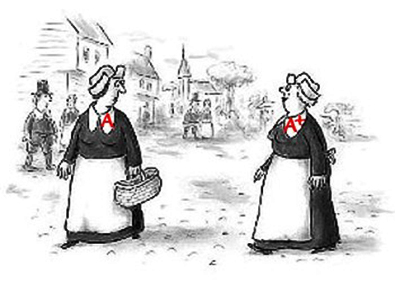
Even though the Pilgrims imposed strict punishment for crimes, they also understood human temptations.  In 1656, Katheren Aines and William Paule were sentenced for committing adultery.  William was whipped and forced to pay the costs of his imprisonment.  Katheren was whipped, imprisoned and forced to wear a letter on her shoulder designating her as an adulteress.  (Calling Nathaniel Hawthorne!)  However, Katheren's husband, Alexander, was also punished.  Alexander had left his family for some time and treated her badly during their marriage.  The Pilgrims viewed him as guilty of "exposing his wife to such temptations."  Alexander was required to pay for his wife's imprisonment, and sit in the stocks while William and Katheren were whipped.

This Thanksgiving as you sit down to your turkey dinner, it might be a good idea to take a moment to be thankful that you aren't subject to Pilgrim or Puritan laws and punishments. :) 

Sunday, November 13, 2022

Those Naughty Pilgrims

With Thanksgiving comes stories of the Pilgrims taking up residence in the new world, landing at Plymouth Rock in what is now the state of Massachusetts.  The pious Pilgrims certainly have a reputation for being a rigid, hard-working, and humorless group.  But there are a few surprises to be found.  Even though drunkenness was discouraged, beer was accepted as a drink for men, women, and also children.  The daily ration on the Mayflower was a gallon a day for each individual.  It took 66 days for them to sail from England to their landing place of Plymouth Rock.  Hmmm…66 days times 1 gallon per person times the number of people on the ship.  It seems that a lot of room on board the ship was devoted to storing the beer ration.

Even sex was not taboo under the right circumstances.  They had a matter-of-fact attitude about sex as long as it was between a married couple.  It's when sex strayed from being the exclusive right between a married couple that the stories get interesting.

Studies by a group of anthropologists at the University of Virginia found that the Pilgrims spent a great deal of time thinking about how to punish those with impure thoughts and actions.  Studies also discovered that in 11% of the marriages at Plymouth Colony the bride was already pregnant.  The same study estimates that as many as 50% of the Pilgrims engaged in premarital sex.  Definitely not an image that fits the stereotype of the staid Pilgrims.

But what about the actions and activities of those naughty Pilgrims?  As with so much in life, there's the façade then there's the underlying reality.

Although not liberal in their thinking or lifestyle, the Pilgrims were not as uptight as history would have us believe and apparently not as uptight as their cousins, the Puritans.  Both the Pilgrims and the Puritans were English Protestants who believed that the Church of England was in need of reform.  Although both groups were strict Calvinists, they differed in their approach to how the Church of England should be reformed.  The Pilgrims were more inclined to separate from the church (therefore known as separatists), while the Puritans wanted to reform the church from within.  The Pilgrims were the first group to seek religious freedom in the New World (thus separating from the church).  As strict Calvinists, members of both groups believed in original sin, predestination, and the literal interpretation of the Bible as God's word.

The Pilgrims tried to create a strict religious society, but had an understanding and mercy unusual for their time in history.  As time passed, however, intolerance grew and was reflected in their laws and clearly demonstrated by the notorious Salem witch trials.  Innocent people were convicted and put to death on evidence that later even the Pilgrims declared to be inadmissible—I saw it in a dream, the spirit of my dead grandmother came to me and said…

According to the Mayflower Compact, the colony was to establish laws based on Biblical teachings "for the glory of God and the advancement of the Christian faith."  The Old Testament book of Leviticus was the basis for most of their laws, a biblical source that definitely predated the New Testament and Christianity's teachings of love and forgiveness rather than reflecting those Old Testament teachings.  Adultery?  Death.  A man has sex with his daughter-in-law?  Death.  Sodomy?  Death.  Bestiality?  Death.  Are you beginning to see a pattern?  :)

But interestingly, the Pilgrims did not typically enforce the death penalty for sex offenses.  There is only one known case in which the convicted offender was actually put to death for sex crimes.  It was the case of Thomas Graunger, a teenage boy apparently at the peak of his raging hormones who sought satisfaction from any and all sources available to him…those sources being the farm animals.

According to Plymouth Governor William Bradford, "He was this year detected of buggery, and indicted for the same, with a mare, a cow, two goats, five sheep, two calves and a turkey."

Even though Thomas was the only one executed for a sex crime, punishments were routinely severe even with far lesser sex crimes and usually meant whippings, being put into the stocks, and fines.

Men were not the only offenders in Plymouth colony.  The prim women weren't always so pious either.  Women were often caught since the evidence of their dalliances were babies.  The records of the times are filled with one out-of-wedlock child after another.  Babies showing up just a few months after marriage were also evidence of wrong doing.  Pre-marital sex was severely punished.  Fines were levied even for making passes, for appearing to have a lascivious carriage in public, or partying in mixed company at an unseemly time of night.

Sex outside marriage, even between two unmarried consenting adults, usually meant a whipping and fines.  If the woman became pregnant, the man had to either marry her or pay for the child's upbringing.  The man was usually placed in the stocks and whipped while the woman was made to watch.  Sometimes mercy was granted as in the case of a servant, Jane Powell.  Following years of hard servitude, she was destitute and had agreed to having sex in the hopes of marrying the man.  Apparently the court found her plea convincing and she went unpunished.

Even though the Pilgrims imposed strict punishment for crimes, they also understood human temptations.  In 1656, Katheren Aines and William Paule were sentenced for committing adultery.  William was whipped and forced to pay the costs of his imprisonment.  Katheren was whipped, imprisoned and forced to wear a letter on her shoulder designating her as an adulteress.  (Calling Nathaniel Hawthorne!)  However, Katheren's husband, Alexander, was also punished.  Alexander had left his family for some time and treated her badly during their marriage.  The Pilgrims viewed him as guilty of "exposing his wife to such temptations."  Alexander was required to pay for his wife's imprisonment, and sit in the stocks while William and Katheren were whipped.

This Thanksgiving as you sit down to your turkey dinner, it might be a good idea to take a moment to be thankful that you aren't a Pilgrim.  :) 

Sunday, November 15, 2020

Those Naughty Pilgrims

With Thanksgiving comes stories of the Pilgrims taking up residence in the new world, landing at Plymouth Rock in what is now the state of Massachusetts.  The pious Pilgrims certainly have a reputation for being a rigid, hard-working, and humorless group.  But there are a few surprises to be found.  Even though drunkenness was discouraged, beer was accepted as a drink for men, women, and also children.  The daily ration on the Mayflower was a gallon a day for each individual.  It took 66 days for them to sail from England to their landing place of Plymouth Rock.  Hmmm…66 days times 1 gallon per person times the number of people on the ship.  It seems that a lot of room on board the ship was devoted to storing the beer ration.

Even sex was not taboo under the right circumstances.  They had a matter-of-fact attitude about sex as long as it was between a married couple.  It's when sex strayed from being the exclusive right between a married couple that the stories get interesting.

Studies by a group of anthropologists at the University of Virginia found that the Pilgrims spent a great deal of time thinking about how to punish those with impure thoughts and actions.  Studies also discovered that in 11% of the marriages at Plymouth Colony the bride was already pregnant.  The same study estimates that as many as 50% of the Pilgrims engaged in premarital sex.  Definitely not an image that fits the stereotype of the staid Pilgrims.

But what about the actions and activities of those naughty Pilgrims?  As with so much in life, there's the façade then there's the underlying reality.

Although not liberal in their thinking or lifestyle, the Pilgrims were not as uptight as history would have us believe and apparently not as uptight as their cousins, the Puritans.  Both the Pilgrims and the Puritans were English Protestants who believed that the Church of England was in need of reform.  Although both groups were strict Calvinists, they differed in their approach to how the Church of England should be reformed.  The Pilgrims were more inclined to separate from the church (therefore known as separatists), while the Puritans wanted to reform the church from within.  The Pilgrims were the first group to seek religious freedom in the New World (thus separating from the church).  As strict Calvinists, members of both groups believed in original sin, predestination, and the literal interpretation of the Bible as God's word.

The Pilgrims tried to create a strict religious society, but had an understanding and mercy unusual for their time in history.  As time passed, however, intolerance grew and was reflected in their laws and clearly demonstrated by the notorious Salem witch trials.  Innocent people were convicted and put to death on evidence that later even the Pilgrims declared to be inadmissible—I saw it in a dream, the spirit of my dead grandmother came to me and said…

According to the Mayflower Compact, the colony was to establish laws based on Biblical teachings "for the glory of God and the advancement of the Christian faith."  The Old Testament book of Leviticus was the basis for most of their laws, a biblical source that definitely predated the New Testament and Christianity's teachings of love and forgiveness rather than reflecting those Old Testament teachings.  Adultery?  Death.  A man has sex with his daughter-in-law?  Death.  Sodomy?  Death.  Bestiality?  Death.  Are you beginning to see a pattern?  :)

But interestingly, the Pilgrims did not typically enforce the death penalty for sex offenses.  There is only one known case in which the convicted offender was actually put to death for sex crimes.  It was the case of Thomas Graunger, a teenage boy apparently at the peak of his raging hormones who sought satisfaction from any and all sources available to him…those sources being the farm animals.

According to Plymouth Governor William Bradford, "He was this year detected of buggery, and indicted for the same, with a mare, a cow, two goats, five sheep, two calves and a turkey."

Even though Thomas was the only one executed for a sex crime, punishments were routinely severe even with far lesser sex crimes and usually meant whippings, being put into the stocks, and fines.

Men were not the only offenders in Plymouth colony.  The prim women weren't always so pious either.  Women were often caught since the evidence of their dalliances were babies.  The records of the times are filled with one out-of-wedlock child after another.  Babies showing up just a few months after marriage were also evidence of wrong doing.  Pre-marital sex was severely punished.  Fines were levied even for making passes, for appearing to have a lascivious carriage in public, or partying in mixed company at an unseemly time of night.

Sex outside marriage, even between two unmarried consenting adults, usually meant a whipping and fines.  If the woman became pregnant, the man had to either marry her or pay for the child's upbringing.  The man was usually placed in the stocks and whipped while the woman was made to watch.  Sometimes mercy was granted as in the case of a servant, Jane Powell.  Following years of hard servitude, she was destitute and had agreed to having sex in the hopes of marrying the man.  Apparently the court found her plea convincing and she went unpunished.

Even though the Pilgrims imposed strict punishment for crimes, they also understood human temptations.  In 1656, Katheren Aines and William Paule were sentenced for committing adultery.  William was whipped and forced to pay the costs of his imprisonment.  Katheren was whipped, imprisoned and forced to wear a letter on her shoulder designating her as an adulteress.  (Calling Nathaniel Hawthorne!)  However, Katheren's husband, Alexander, was also punished.  Alexander had left his family for some time and treated her badly during their marriage.  The Pilgrims viewed him as guilty of "exposing his wife to such temptations."  Alexander was required to pay for his wife's imprisonment, and sit in the stocks while William and Katheren were whipped.

This Thanksgiving as you sit down to your turkey dinner, it might be a good idea to take a moment to be thankful that you aren't a Pilgrim.  :)

Sunday, November 8, 2020

Thanksgiving Myths and Facts

This year, the Thanksgiving holiday in the U.S. falls on Thursday, November 26, 2020.

We all know the often told story of how the Pilgrims left England seeking religious freedom and finally settled in the New World, stepping off the Mayflower onto Plymouth Rock in what is now the state of Massachusetts.  And how in 1621 they invited the local natives to share a feast with them in order to give thanks for a successful harvest and surviving their first year.

From those humble beginnings have come many facts and just as many myths about the Pilgrims and our Thanksgiving holiday.

I have some Mayflower myths to share with you, followed by some Thanksgiving facts.

Myth:  The first Thanksgiving was in 1621 and the Pilgrims celebrated it every year after that.

Fact:  The first feast wasn't repeated, so it wasn't the beginning of a tradition.  In fact, it wouldn't have been called Thanksgiving because to the Pilgrims a thanksgiving was a religious holiday when they would fast rather than feast.  That feast in 1621 was a secular celebration and would not have been considered a thanksgiving in their minds.

Myth:  The original Thanksgiving feast took place on the fourth Thursday of November.

Fact:  The original feast in 1621 occurred sometime between September 21 and November 11 and was a three day celebration based on the English harvest festivals.  In 1863, Abraham Lincoln declared the last Thursday of November as Thanksgiving. In 1939, President Franklin D. Roosevelt set the official date for Thanksgiving as the fourth Thursday of November, a decision fraught with controversy.  The date was approved by Congress in 1941.

Myth:  The Pilgrims wore only black and white clothing with buckles on their hats, garments, and shoes as shown in numerous paintings.

Fact:  Buckles did not come into fashion until later in the 17th century.  Black and white were commonly worn only on Sunday and formal occasions.

Here's a list of trivia that could be called Thanksgiving-by-the-numbers.

3,000—the number of calories eaten during an average Thanksgiving meal.

12,000,000—the number of whole turkeys Butterball sells for Thanksgiving.

2,000 - 3,000—the number of people used to guide the balloons during the Macy's Thanksgiving Day Parade. [this year, COVID-19 has changed this traditional event]

214—the average number of miles driven for the family get together at Thanksgiving. [due to COVID-19, many traditional family get togethers are being cancelled]

1939—the date the Great Thanksgiving Day calendar controversy began (when FDR declared the fourth Thursday of November to be the official date of Thanksgiving).

40,000,000—the number of green bean casseroles made for Thanksgiving dinner.

72,000,000—the number of cans of Ocean Spray cranberry sauce sold for Thanksgiving dinner. 

Sunday, November 17, 2019

Those Naughty Pilgrims

With Thanksgiving comes stories of the Pilgrims taking up residence in the new world, landing at Plymouth Rock in what is now the state of Massachusetts.  The pious Pilgrims certainly have a reputation for being a rigid, hard-working, and humorless group.  But there are a few surprises to be found.  Even though drunkenness was discouraged, beer was accepted as a drink for men, women, and also children.  The daily ration on the Mayflower was a gallon a day for each individual.  It took 66 days for them to sail from England to their landing place of Plymouth Rock.  Hmmm…66 days times 1 gallon per person times the number of people on the ship.  It seems that a lot of room on board the ship was devoted to storing the beer ration.

Even sex was not taboo under the right circumstances.  They had a matter-of-fact attitude about sex as long as it was between a married couple.  It's when sex strayed from being the exclusive right between a married couple that the stories get interesting.

Studies by a group of anthropologists at the University of Virginia found that the Pilgrims spent a great deal of time thinking about how to punish those with impure thoughts and actions.  Studies also discovered that in 11% of the marriages at Plymouth Colony the bride was already pregnant.  The same study estimates that as many as 50% of the Pilgrims engaged in premarital sex.  Definitely not an image that fits the stereotype of the staid Pilgrims.

But what about the actions and activities of those naughty Pilgrims?  As with so much in life, there's the façade then there's the underlying reality.

Although not liberal in their thinking or lifestyle, the Pilgrims were not as uptight as history would have us believe and apparently not as uptight as their cousins, the Puritans.  Both the Pilgrims and the Puritans were English Protestants who believed that the Church of England was in need of reform.  Although both groups were strict Calvinists, they differed in their approach to how the Church of England should be reformed.  The Pilgrims were more inclined to separate from the church (therefore known as separatists), while the Puritans wanted to reform the church from within.  The Pilgrims were the first group to seek religious freedom in the New World (thus separating from the church).  As strict Calvinists, members of both groups believed in original sin, predestination, and the literal interpretation of the Bible as God's word.
The Pilgrims tried to create a strict religious society, but had an understanding and mercy unusual for their time in history.  As time passed, however, intolerance grew and was reflected in their laws and clearly demonstrated by the notorious Salem witch trials.  Innocent people were convicted and put to death on evidence that later even the Pilgrims declared to be inadmissible—I saw it in a dream, the spirit of my dead grandmother came to me and said…

According to the Mayflower Compact, the colony was to establish laws based on Biblical teachings "for the glory of God and the advancement of the Christian faith."  The Old Testament book of Leviticus was the basis for most of their laws, a biblical source that definitely predated the New Testament and Christianity's teachings of love and forgiveness rather than reflecting those Old Testament teachings.  Adultery?  Death.  A man has sex with his daughter-in-law?  Death.  Sodomy?  Death.  Bestiality?  Death.  Are you beginning to see a pattern?  :)

But interestingly, the Pilgrims did not typically enforce the death penalty for sex offenses.  There is only one known case in which the convicted offender was actually put to death for sex crimes.  It was the case of Thomas Graunger, a teenage boy apparently at the peak of his raging hormones who sought satisfaction from any and all sources available to him…those sources being the farm animals.

According to Plymouth Governor William Bradford, "He was this year detected of buggery, and indicted for the same, with a mare, a cow, two goats, five sheep, two calves and a turkey."

Even though Thomas was the only one executed for a sex crime, punishments were routinely severe even with far lesser sex crimes and usually meant whippings, being put into the stocks, and fines.

Men were not the only offenders in Plymouth colony.  The prim women weren't always so pious either.  Women were often caught since the evidence of their dalliances were babies.  The records of the times are filled with one out-of-wedlock child after another.  Babies showing up just a few months after marriage were also evidence of wrong doing.  Pre-marital sex was severely punished.  Fines were levied even for making passes, for appearing to have a lascivious carriage in public, or partying in mixed company at an unseemly time of night.

Sex outside marriage, even between two unmarried consenting adults, usually meant a whipping and fines.  If the woman became pregnant, the man had to either marry her or pay for the child's upbringing.  The man was usually placed in the stocks and whipped while the woman was made to watch.  Sometimes mercy was granted as in the case of a servant, Jane Powell.  Following years of hard servitude, she was destitute and had agreed to having sex in the hopes of marrying the man.  Apparently the court found her plea convincing and she went unpunished.

Even though the Pilgrims imposed strict punishment for crimes, they also understood human temptations.  In 1656, Katheren Aines and William Paule were sentenced for committing adultery.  William was whipped and forced to pay the costs of his imprisonment.  Katheren was whipped, imprisoned and forced to wear a letter on her shoulder designating her as an adulteress.  (Calling Nathaniel Hawthorne!)  However, Katheren's husband, Alexander, was also punished.  Alexander had left his family for some time and treated her badly during their marriage.  The Pilgrims viewed him as guilty of "exposing his wife to such temptations."  Alexander was required to pay for his wife's imprisonment, and sit in the stocks while William and Katheren were whipped.

This Thanksgiving as you sit down to your turkey dinner, it might be a good idea to take a moment to be thankful that you aren't a Pilgrim.  :)

Sunday, November 10, 2019

Thanksgiving—Canada vs. U.S.

Even though Canada was first to celebrate Thanksgiving, decades before the Pilgrims arrived in what is now the United States, the holiday in the U.S. and its northern neighbor have much in common.

For those of us in the United States, imagine the Thanksgiving holiday a month and a half earlier. There's plenty of pumpkin pie but not a Pilgrim in sight. For 37 million Canadians, that's reality for the second Monday in October. Many of the trappings of Canadian Thanksgiving are similar to those of its U.S. counterpart, but the Canadian tradition belongs to the 16th century, more than four decades before the historic 17th century gathering in Plymouth, Massachusetts, in 1621 that is the genesis of the American Thanksgiving holiday.

The original Canadian Thanksgiving feast in 1578 consisted of biscuits, salt beef, and mushy peas. That's when Sir Martin Frobisher sailed from England in search of the Northwest Passage. After his crew arrived in what is now Nunavut (newly created April 1, 1999, formerly part of the Northwest Territories), Frobisher's men took part in a Church of England service of thanksgiving.

Both Native Americans and Indigenous Canadians had long celebrated the fall harvest. European settlers attempted to follow suit as they settled on the Canadian mainland. Early attempts at French settlement along Canada's Atlantic coast had been disastrous, and ended in 1604 with a scurvy epidemic that took place after French settlers ignored warnings that winter ice would trap them on Île-Ste.-Croix, an island in the Bay of Fundy. They ended up isolated on the island for months. Half of the group died of scurvy before being rescued by Indigenous Canadians.

Those who survived moved to Port Royal in what is now Nova Scotia, where Samuel de Champlain mandated a series of feasts designed to keep the settlers' spirits up. The feasts kicked off in 1616 with a Thanksgiving-like November event that included the Mi'kmaq people.

As in the U.S., Canada observed occasional Thanksgivings to celebrate important events such as the end of the War of 1812. And like the U.S., Canada's first thanksgivings tended to be religious events. The two countries also celebrated similarly thanks to pro-British Loyalists who moved to Canada during and after the Revolutionary War. New England staples like turkey and pumpkin were introduced to the Canadian celebration.

Thanksgiving became a national celebration in Canada starting in 1859, again beating the United States to the holiday. Abraham Lincoln set the precedent for the annual holiday in the U.S. after the Battle of Gettysburg in 1863, when he set the date at the last Thursday of November.

Unlike American Thanksgiving, Canada's national Thanksgiving date took decades to become standardized and annual. In 1957, Canada's parliament set the date as the second Monday in October. By then, the United States was officially celebrating their Thanksgiving on the fourth Thursday of November.

Though plenty of Canadians celebrate Thanksgiving, it's not a public holiday in three of the country's provinces: Nova Scotia, Prince Edward Island, and New Brunswick. In Quebec, which has strong Catholic roots, the holiday has historically been downplayed. And Canadian Thanksgiving isn't the major travel and shopping event it has become in the United States. The holiday may have come earlier to Canada, but its southern cousin is much more invested in celebrating it.

Sunday, November 18, 2018

Those Naughty Pilgrims part 2 of 2

Welcome to part two of my two-part Thanksgiving blog.

With Thanksgiving comes stories of the Pilgrims taking up residence in the new world, landing at Plymouth Rock in what is now the state of Massachusetts.  The pious Pilgrims certainly have a reputation for being a rigid, hard-working, and humorless group.  But there are a few surprises to be found.  Even though drunkenness was discouraged, beer was accepted as a drink for men, women, and also children.  The daily ration on the Mayflower was a gallon a day for each individual.  It took 66 days for them to sail from England to their landing place of Plymouth Rock.  Hmmm…66 days times 1 gallon per person times the number of people on the ship.  It seems that a lot of room on board the ship was devoted to storing the beer ration.

Even sex was not taboo under the right circumstances.  They had a matter-of-fact attitude about sex as long as it was between a married couple.  It's when sex strayed from being the exclusive right between a married couple that the stories get interesting.

Studies by a group of anthropologists at the University of Virginia found that the Pilgrims spent a great deal of time thinking about how to punish those with impure thoughts and actions.  Studies also discovered that in 11% of the marriages at Plymouth Colony the bride was already pregnant.  The same study estimates that as many as 50% of the Pilgrims engaged in premarital sex.  Definitely not an image that fits the stereotype of the staid Pilgrims.

But what about the actions and activities of those naughty Pilgrims?  As with so much in life, there's the façade then there's the underlying reality.

Although not liberal in their thinking or lifestyle, the Pilgrims were not as uptight as history would have us believe and apparently not as uptight as their cousins, the Puritans.  Both the Pilgrims and the Puritans were English Protestants who believed that the Church of England was in need of reform.  Although both groups were strict Calvinists, they differed in their approach to how the Church of England should be reformed.  The Pilgrims were more inclined to separate from the church (therefore known as separatists), while the Puritans wanted to reform the church from within.  The Pilgrims were the first group of Puritans to seek religious freedom in the New World (thus separating from the church).  As strict Calvinists, members of both groups believed in original sin, predestination, and the literal interpretation of the Bible as God’s word.

The Pilgrims tried to create a strict religious society, but had an understanding and mercy unusual for their time in history.  As time passed, however, intolerance grew and was reflected in their laws and clearly demonstrated by the notorious Salem witch trials.  Innocent people were convicted and put to death on evidence that later even the Pilgrims declared to be inadmissible—I saw it in a dream, the spirit of my dead grandmother came to me and said…

According to the Mayflower Compact, the colony was to establish laws based on Biblical teachings "for the glory of God and the advancement of the Christian faith."  The Old Testament book of Leviticus was the basis for most of their laws, a biblical source that definitely predated the New Testament and Christianity's teachings of love and forgiveness rather than reflecting those Old Testament teachings.  Adultery?  Death.  A man has sex with his daughter-in-law?  Death.  Sodomy?  Death.  Bestiality?  Death.  Are you beginning to see a pattern?  :)

But interestingly, the Pilgrims did not typically enforce the death penalty for sex offenses.  There is only one known case in which the convicted offender was actually put to death for sex crimes.  It was the case of Thomas Graunger, a teenage boy apparently at the peak of his raging hormones who sought satisfaction from any and all sources available to him…those sources being the farm animals.

According to Plymouth Governor William Bradford, "He was this year detected of buggery, and indicted for the same, with a mare, a cow, two goats, five sheep, two calves and a turkey."

Even though Thomas was the only one executed for a sex crime, punishments were routinely severe even with far lesser sex crimes and usually meant whippings, being put into the stocks, and fines.

Men were not the only offenders in Plymouth colony.  The prim women weren't always so pious either.  Women were often caught since the evidence of their dalliances were babies.  The records of the times are filled with one out-of-wedlock child after another.  Babies showing up just a few months after marriage were also evidence of wrong doing.  Pre-marital sex was severely punished.  Fines were levied even for making passes, for appearing to have a lascivious carriage in public, or partying in mixed company at an unseemly time of night.

Sex outside marriage, even between two unmarried consenting adults, usually meant a whipping and fines.  If the woman became pregnant, the man had to either marry her or pay for the child's upbringing.  The man was usually placed in the stocks and whipped while the woman was made to watch.  Sometimes mercy was granted as in the case of a servant, Jane Powell.  Following years of hard servitude, she was destitute and had agreed to having sex in the hopes of marrying the man.  Apparently the court found her plea convincing and she went unpunished.

Even though the Pilgrims imposed strict punishment for crimes, they also understood human temptations.  In 1656, Katheren Aines and William Paule were sentenced for committing adultery.  William was whipped and forced to pay the costs of his imprisonment.  Katheren was whipped, imprisoned and forced to wear a letter on her shoulder designating her as an adulteress.  (Calling Nathaniel Hawthorne!)  However, Katheren's husband, Alexander, was also punished.  Alexander had left his family for some time and treated her badly during their marriage.  The Pilgrims viewed him as guilty of "exposing his wife to such temptations."  Alexander was required to pay for his wife's imprisonment, and sit in the stocks while William and Katheren were whipped.

This Thanksgiving as you sit down to your turkey dinner, it might be a good idea to take a moment to be thankful that you aren't a Pilgrim.  :)

Sunday, November 20, 2016

Those Naughty Pilgrims

When I started my 3 part series on historical trivia and where we got some of the expressions we use daily, it hadn't occurred to me that Thanksgiving came during that 3 week period of time.  So, I'm postponing part 3 of 3 until next week and am acknowledging Thanksgiving with this week's blog.

With Thanksgiving comes stories of the Pilgrims taking up residence in the new world, landing at Plymouth Rock in what is now the state of Massachusetts.  The pious Pilgrims certainly have a reputation for being a rigid, hard-working, and humorless group.  But there are a few surprises to be found.  Even though drunkenness was discouraged, beer was accepted as a drink by men, women, and also children.  The daily ration on the Mayflower was a gallon a day for each individual.  It took 66 days for them to sail from England to their landing place of Plymouth Rock.  Hmmm…66 days times 1 gallon per person times the number of people on the ship.  It seems that a lot of room on board the ship was devoted to storing the beer ration.

Even sex was not taboo under the right circumstances.  They had a matter-of-fact attitude about sex as long as it was between a married couple.  It's when sex strayed from being the exclusive right between a married couple that the stories get interesting.

Studies by a group of anthropologists at the University of Virginia found that the Pilgrims spent a great deal of time thinking about how to punish those with impure thoughts and actions.  Studies also discovered that in 11% of the marriages at Plymouth Colony the bride was already pregnant.  The same study estimates that as many as 50% of the Pilgrims engaged in premarital sex.  Definitely not an image that fits the stereotype of the staid Pilgrims.

But what about the actions and activities of those naughty Pilgrims?  As with so much in life, there's the façade and then there's the underlying reality.

Although not liberal in their thinking or lifestyle, the Pilgrims were not as uptight as history would have us believe and apparently not as uptight as their cousins, the Puritans.  Both the Pilgrims and the Puritans were English Protestants who believed that the Church of England was in need of reform.  Although both groups were strict Calvinists, they differed in their approach to how the Church of England should be reformed.  The Pilgrims were more inclined to separate from the church (therefore known as separatists), while the Puritans wanted to reform the church from within.  The Pilgrims were the first group of Puritans to seek religious freedom in the New World (thus separating from the church).  As strict Calvinists, members of both groups believed in original sin, predestination and the literal interpretation of the Bible as God’s word.

The Pilgrims tried to create a strict religious society, but had an understanding and mercy unusual for their time in history.  As time passed, however, intolerance grew and was reflected in their laws and clearly demonstrated by the notorious Salem witch trials.  Innocent people were convicted and put to death on evidence that later even the Pilgrims declared to be inadmissible (I saw it in a dream, the spirit of my dead grandmother came to me and said…).

According to the Mayflower Compact, the colony was to establish laws based on Biblical teachings "for the glory of God and the advancement of the Christian faith."  The Old Testament book of Leviticus was the basis for most of their laws, a biblical source that definitely predated Christianity's teachings of love and forgiveness rather than reflecting those teachings.  Adultery?  Death.  A man has sex with his daughter-in-law?  Death.  Sodomy?  Death.  Bestiality?  Death.  Are you beginning to see a pattern?  :)

But interestingly, the Pilgrims did not typically enforce the death penalty for sex offenses.  There is only one known case in which the convicted offender was actually put to death for sex crimes.  It was the case of Thomas Graunger, a teenage boy apparently at the peak of his raging hormones who sought satisfaction from any and all sources available to him…those sources being the farm animals.

According to Plymouth Governor William Bradford, "He was this year detected of buggery, and indicted for the same, with a mare, a cow, two goats, five sheep, two calves and a turkey."

Even though Thomas was the only one executed for a sex crime, punishments were routinely severe even with far lesser sex crimes and usually meant whippings, being put into the stocks, and fines.

Men were not the only offenders in Plymouth colony.  The prim women weren't always so pious either.  Women were often caught since the evidence of their dalliances were babies.  The records of the times are filled with one out-of-wedlock child after another.  Babies showing up just a few months after marriage were also evidence of wrong doing.  Pre-marital sex was severely punished.  Fines were levied even for making passes, for appearing to have a lascivious carriage in public, or partying in mixed company at an unseemly time of night.

Sex outside marriage, even between two unmarried consenting adults, usually meant a whipping and fines.  If the woman became pregnant, the man had to either marry her or pay for the child's upbringing.  The man was usually placed in the stocks and whipped while the woman was made to watch.  Sometimes mercy was granted as in the case of a servant, Jane Powell.  Following years of hard servitude, she was destitute and had agreed to having sex in the hopes of marrying the man.  Apparently the court found her plea convincing and she went unpunished.

Even though the Pilgrims imposed strict punishment for crimes, they also understood human temptations.  In 1656, Katheren Aines and William Paule were sentenced for committing adultery.  William was whipped and forced to pay the costs of his imprisonment.  Katheren was whipped, imprisoned and forced to wear a letter on her shoulder designating her as an adulteress.  (Calling Nathaniel Hawthorne!)  However, Katheren's husband, Alexander, was also punished.  Alexander had left his family for some time and treated her badly during their marriage.  The Pilgrims viewed him as guilty of "exposing his wife to such temptations."  Alexander was required to pay for his wife's imprisonment, and sit in the stocks while William and Katheren were whipped.

This Thanksgiving as you sit down to your turkey dinner, it might be a good idea to take a moment to be thankful that you aren't a Pilgrim.  :)