Showing posts with label state facts. Show all posts

Sunday, May 5, 2024

Important Historical Event in Each State—part 3 of 5

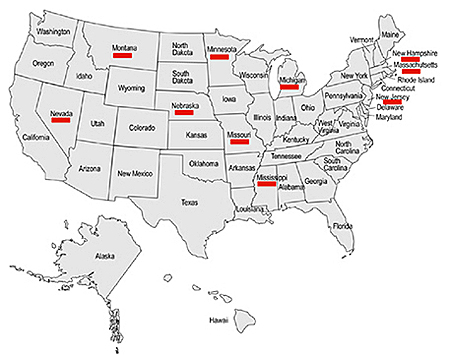
This week I'm covering Massachusetts through New Jersey in part 3 of my 5 part blog series showing an important historical event from each state.

21. Massachusetts

Event: Battle of Lexington

Year: 1775

Location: Lexington

Resentment toward the English crown was very intense in Lexington and that was where the militiamen from Massachusetts chose to stand their ground against the British Empire. As battles go, the Battle of Lexington was little more than a skirmish. The British killed eight militiamen and wounded nine others at Lexington, then they continued on to Concord to destroy munitions stored there. But when the British tried to return to Boston, more colonists attacked them, killing or wounding 250 British soldiers. The American Revolution had begun.

22. Michigan

Event: Model T built

Year: 1908

Location: Detroit

The Model T built by Henry Ford revolutionized travel in the United States. It was constructed to make car ownership affordable to average American workers. Ford built more than 15 million of the vehicles, also called the "Tin Lizzie," from 1908 to 1927. Most models were started by a hand crank and reached top speeds of 45 miles an hour. Ford and others decided to build cars in Michigan because of the availability of iron ore and timber, and the rail and water routes made it convenient to ship cars to large cities such as Chicago and New York City.

23. Minnesota

Event: Mayo Clinic founded

Year: 1864

Location: Rochester

The Mayo Clinic has become the standard by which all hospitals are measured. The institution was chosen as the best hospital in the nation by U.S. News and World Report. The Mayo Clinic has its roots in immigrant founders Dr. William Worrall Mayo and Mother Alfred Moes, each of whom took separate routes to Rochester before they founded the hospital. Their visions of hospital care and teams of specialists have been realized today. In 1919, the institution became a not-for-profit organization.

24. Mississippi

Event: Lynching of Emmett Till

Year: 1955

Location: Money

The lynching of 14-year-old African American Emmett Till shocked the nation and served as a catalyst for the civil rights movement. Till, a Chicago resident, was visiting relatives in Mississippi. He was kidnapped and killed after white residents in the town of Money claimed he whistled at a white woman. When Till's body was found, it had been grotesquely disfigured. His mother chose to have an open casket at his wake to show the world the horror of the crime. There was a trial and the accused murders were acquitted by an all-white, male jury. In January 2017, Timothy Tyson, author of The Blood of Emmett Till, said the woman whom Till allegedly made advances toward told him she lied about the incident.

25. Missouri

Event: Admitted as slave state

Year: 1820

Location: Statewide

Tensions between slave states and free states were rising in the United States in the early 19th century, particularly over the issue of whether the expanding nation should admit new states as free or slave states. In 1820, Congress passed legislation known as the Missouri Compromise that maintained the balance of power between free states and slave states. The compromise allowed the admission of Missouri as a slave state and Maine as a free state. Neither the North nor the South was happy with the compromise, but the Union managed to hold together for another 41 years before it finally erupted into the Civil War.

26. Montana

Event: Battle of the Little Bighorn

Year: 1876

Location: Little Big Horn

We've all heard the story of Custer's Last Stand. In 1876, George Armstrong Custer led U.S. Army soldiers to forcibly relocate members of the Sioux and Cheyenne tribes after gold was discovered on their lands. Thousands of Native Americans, led by Sitting Bull and Crazy Horse, rallied at the Little Bighorn River. Custer was ordered to wait for reinforcements, but he attacked the main encampment of the tribes. Custer and his soldiers were overwhelmed and all killed within an hour. That would be the last decisive victory of indigenous tribes against the Army, as the government increased the use of force to put down any rebellions.

27. Nebraska

Event: Kansas-Nebraska Act

Year: 1854

Location: Statewide

The Kansas-Nebraska Act allowed people in the territories of Kansas and Nebraska to decide if the state would be a slave state or a free state. The legislation prompted settlers on each side of the slavery issue to pour into Kansas to affect the outcome of the first election after the law had passed. The election results produced violence, earning the state the name "Bleeding Kansas." A pro-slavery legislature was chosen amid charges of fraud. Because of this, Congress refused to admit Kansas as a state. Anti-slavery settlers eventually outnumbered pro-slavery supporters and Kansas was admitted as a free state just before the Civil War.

28. Nevada

Event: Gambling legalized

Year: 1931

Location: Statewide

With the nation in the throes of the Great Depression, Nevada became the first state to legalize gambling in 1931 as a mean of creating a revenue source. The decision would have profound consequences for the state and the nation. At the time, Las Vegas was nothing more than a desert stopover. The construction of nearby Hoover Dam gave the area a big boost. Gambling and casinos, run by organized crime, turned Las Vegas into an entertainment colossus.

29. New Hampshire

Event: First government independent from England

Year: 1776

Location: Statewide

New Hampshire's state motto is "Live Free or Die," so it shouldn't be surprising that the state was the first to declare itself independent from England. The state set up its own government away from colonial rule in January 1776, months before the Continental Congress. In 1778, it was also the first state to hold a constitutional convention.

30. New Jersey

Event: Battle of Trenton

Year: 1776

Location: Trenton

By the end of 1776, the Continental Army was in trouble. It had been beaten in New York and chased across New Jersey into Pennsylvania by the British Army. General George Washington needed a victory to lift the hopes of the budding nation. He took a risk by crossing an ice-choked Delaware River the day after Christmas to surprise the Hessian troops billeted at Trenton. The Army killed or captured the entire force of 1,400 Hessians. The victory boosted Americans' belief in the cause of fighting to liberate themselves from British rule.

Next week is part 4 of 5 covering New Mexico through South Carolina. 

Sunday, April 28, 2024

Important Historical Event in Each State—part 2 of 5

This week is part 2 of 5 of my series highlighting an important historical event in each State. This week's blog post covers Hawaii through Maryland.

11. Hawaii

Event: Attack on Pearl Harbor

Year: 1941

Location: Honolulu

The Japanese Empire's assault on the United States naval fleet at Pearl Harbor was a surprise attack, though relations between the two nations had been deteriorating for years. The United States did not think an attack would occur near the U.S. mainland, and the naval facilities at Pearl Harbor, where the fleet was based, were not well defended. The attack destroyed 20 American ships, more than 300 airplanes, and killed more than 2,400 people. Fortunately for America, oil storage depots, repair shipyards, and other facilities in Hawaii were not destroyed. The U.S. aircraft carriers were not in Hawaii at the time. The attack brought the United States into World War II.

12. Idaho

Event: The Big Burn

Year: 1910

Location: Northern Idaho

In 1910, the Western United States suffered a severe drought that left much of the wilderness susceptible to fire. The extreme conditions led to The Big Burn, a massive forest fire that scorched over 3 million acres of land across Montana, Washington, and Idaho killing 87 people with at least 78 of them firefighters. The deaths and wide spread damage started a renewed interest in conservation among the American people. President Theodore Roosevelt attempted to acquire land for the national forest system after his election in 1904, but Congress refused. The Big Burn shifted public interest, and in 1911, Congress passed a law leading to the purchase of more than 20 million acres of land for the national forest system. The National Forest Service's budget was doubled.

13. Illinois

Event: Chicago Fire

Year: 1871

Location: Chicago

Prolonged dry weather and the haphazard construction of wooden structures all contributed to the conditions for the Chicago Fire. The blaze killed 300 people, destroyed thousands of buildings, and damaged an estimated $200 million worth of property. Luckily for the city, its transportation infrastructure was left intact. In the wake of the conflagration, Chicago implemented stricter building and fire codes. From the ruins emerged the nation's first skyscrapers and a teeming metropolis.

14. Indiana

Event: Native American Uprising

Year: 1811

Location: Tippecanoe

By the early 19th century, Native American tribes had enough of white settlers moving into their lands. Shawnee Chief Tecumseh organized a resistance and set up a village in Central Indiana. Gov. William Henry Harrison led approximately 1,100 men to confront them. Tecumseh's brother, Tenskwatawa, initially requested a ceasefire, but he broke it and attacked the militia in the early morning. Harrison's troops endured the attack and eventually forced the native fighters to retreat. Though Harrison lost more troops than the tribes, he developed a reputation as a war hero that eventually helped him get elected president decades later.

15. Iowa

Event: Creation of caucuses

Year: 1976

Location: Statewide

The caucuses are unique to Iowa in its political procedure of selecting presidential candidates. For candidates such as Jimmy Carter, success at the caucuses in 1976 generated momentum toward his eventual nomination for president. The process emerged out of the chaos of the 1968 Democratic National Convention in Chicago. For the Democrats, the caucuses are akin to a neighborhood meeting in which supporters of a particular candidate make their pitch to caucus-goers. Caucus attendees then gather in groups in various parts of the room for the candidate of their choice. The elected chairperson of the caucus counts the supporters of each candidate. The Republican process is less complicated.

16. Kansas

Event: Brown vs. Board of Education of Topeka

Year: 1954

Location: Topeka

The Supreme Court's decision in the Brown v. Board of Education case provided one of the first major victories of the civil rights movement. Oliver Brown sued the Topeka, Kansas, Board of Education, saying the city's schools for black students were not as good as those for white students. The case made it to the Supreme Court in 1952, where the justices ruled that the idea of public facilities being "separate but equal" was unconstitutional. This decision made racial integration the law of the land and marked a major step forward in U.S. history.

17. Kentucky

Event: Fort Knox starts holding gold bullion

Year: 1937

Location: Fort Knox

Opened in 1937, the United States Bullion Depository in Fort Knox stores the nation's gold reserves. It is one of six U.S. Mint facilities and is located next to a U.S. Army garrison. Shortly after the attack on Pearl Harbor, the holdings swelled to 649.6 million ounces, the highest amount ever held there. The gold is kept in the form of bars measuring 7 inches in length, 3.625 inches in width, and are 1.75 inches thick. The depository has held other valuables such as the Magna Carta, the Declaration of Independence, and the Constitution.

18. Louisiana

Event: Hurricane Katrina

Year: 2005

Location: Southeastern Louisiana

Hurricane Katrina slammed into the Gulf of Mexico in August 2005. The hurricane hit several states, but Louisiana took the brunt of the storm. Katrina battered New Orleans and the surrounding area with 127 mile per hour winds. Most of the levees in New Orleans failed, leading to overwhelming flooding. The Federal Emergency Management Agency estimated that 1,833 people were killed either directly or indirectly as a result of Hurricane Katrina. Over 1,500 of those fatalities were in Louisiana. The storm also caused over $108 billion in damages.

19. Maine

Event: The Year Maine Burned

Year: 1947

Location: Statewide

In 1947, Maine received about half of its normal rainfall for the summer and into the fall, setting up dry conditions that led to a fire. The blaze began on Oct. 17 in a cranberry bog. Strong winds fanned the flames, spreading the fire until it eventually engulfed more than 17,000 acres, including 10,000 acres of Acadia National Park. Today, the aftermath of the fire at the park can be seen in the diversity of its scenery. Nature has replaced many evergreen trees by a colorful spread of deciduous trees. That fire was a prelude for the rest of the year. The fall of 1947 saw many other serious fires. By the end of the year, more than 200,000 acres and 1,000 homes had been destroyed. The repeated destruction earned 1947 the nickname "The Year Maine Burned."

20. Maryland

Event: The Toleration Act

Year: 1649

Location: Statewide

The colony of Maryland was settled in 1634 with the intention of expanding religious freedoms compared to England at the time. Anglicans and Catholics were often at odds, which made it a surprise when the charter for Maryland was given to a Catholic family from the Anglican King James. Maryland sealed its reputation as a haven for religious liberty when it passed the Toleration Act, which said that no one who "professes to believe in Jesus Christ, shall from henceforth be any way troubled, harassed or embarrassed for…his or her religion." Although restrictive by today's standards, it was a big step in the 17th century.

Next week in part 3 of 5, I'll present Massachusetts through New Jersey.

Sunday, April 18, 2021

Important Historical Event in Each State—part 4 of 5 New Mexico-South Carolina

This week, part 4 of my 5 part blog series about historical events in the states covers New Mexico to South Carolina.

31. New Mexico

Event: Atomic bomb testing

Year: 1945

Location: Alamogordo

Scientists detonated the first atomic bomb on July 16, 1945, in the New Mexico desert, and from that moment on the world would never be the same. The nuclear test was code-named "Trinity." The following month atomic weapons were used against the Japanese cities of Hiroshima and Nagasaki with such devastating results that the Japanese surrendered shortly after. The Soviet Union set off its first atomic bomb in 1949, ratcheting up Cold War tensions.

32. New York

Event: Sept. 11 terrorist attacks

Year: 2001

Location: New York City

On September 11, 2001, two hijacked commercial airplanes hit the Twin Towers of the World Trade Center in New York City. The skyscrapers collapsed trapping thousands of people and first responders. In all, close to 3,000 people died in the attacks. Another hijacked plane hit the Pentagon and another was brought down in a field in Pennsylvania by the passengers, sacrificing their lives to stop the attack. The destination of the hijackers of the downed plane was believed to be Washington, D.C.—either the White House or the Capitol building.

33. North Carolina

Event: Manned flight

Year: 1903

Location: Kitty Hawk

Though the Wright Brothers grew up in Ohio, they found the perfect place for their flying machine experiments in Kitty Hawk, North Carolina. The brothers pored over weather records before determining that North Carolina would suit their needs. The first flight lasted just 12 seconds and covered 120 feet. By the end of the day, the world's first airplane stayed in the air for nearly one minute. There was another inventor of the time who also had created a heavier-than-air flying machine and tested it before the Wright Brothers event at Kitty Hawk. Unlike the Wright Brothers, he had his drawings and notes but no proof of his successful flight. The Wright Brothers had filmed their flying event.

34. North Dakota

Event: Standing Rock protest

Year: 2016

Location: Standing Rock reservation

In 2016 and 2017, a protest against a proposed oil pipeline grabbed the nation's attention. The Dakota Access Pipeline route in North Dakota ran through Standing Rock Sioux Reservation and under the Missouri River, the reservation's source for drinking water. Residents protested, fearing the oil would contaminate the water. Hundreds of Native American activists and their allies descended on the reservation to protest what reservation residents believed was an encroachment on their sacred lands and a threat to their crucial water supply. Dozens of protesters were arrested, and the Obama administration blocked the project. Though the Trump administration has since reversed the decision and construction of the pipeline was completed, the company responsible for the pipeline is facing a litany of lawsuits that claim its security officers used unnecessary force on those protesting.

35. Ohio

Event: Ohio and Erie canal opened

Year: 1833

Location: Ohio and Erie Canal

During the early days of Ohio's history, the area was tough to access from much of the country due to its geography and lack of infrastructure. An ambitious construction project which became known as the Ohio and Erie Canal sought to change that. The canal, which took nearly seven years to build, now serves as a 110-mile link between the Ohio River and Lake Erie. In addition to connecting two sides of Ohio, the canal provided an important link between the Midwest and the East Coast. Before the canal, it cost $125 to ship a ton of goods between the Ohio and the east coast. After the canal became functional, the price dropped to $25 per ton.

36. Oklahoma

Event: Federal Building bombing

Year: 1995

Location: Oklahoma City

Before the Twin Towers attack on Sept. 11, 2001, the worst terror attack on American soil was committed by domestic terrorists. The attack killed 168 people, injured about 650 others, and damaged some 300 buildings. Anti-government militant Timothy McVeigh loaded a truck with explosive materials and detonated it outside the Alfred Murrah Federal Building in Oklahoma City. He chose that building because it contained the offices of federal agencies—the Drug Enforcement Agency, Secret Service, and the Bureau of Alcohol, Tobacco and Firearms and Explosives. McVeigh was captured, tried in Federal Court under Federal laws, and eventually executed. Co-conspirator Terry Nichols was tried in State court under Oklahoma state laws, and sentenced to life in prison.

37. Oregon

Event: Lewis and Clark Expedition

Year: 1806

Location: Clatsop County

Shortly after the Louisiana Purchase, President Thomas Jefferson asked Meriwether Lewis to lead an expedition to explore the new land west of the Mississippi River. Lewis was joined by William Clark as co-commander and other adventurers who became known as the Corps of Discovery. In 1804, they set out from St. Louis in what is now Missouri. More than a year later, they arrived at the northwestern tip of what is now Oregon where the Columbia River meets the Pacific Ocean. There they constructed Fort Clatsop to ride out the winter. In 1806, they returned to St. Louis to complete their nearly 8,000-mile round trip journey.

38. Pennsylvania

Event: Signing of Declaration of Independence

Year: 1776

Location: Philadelphia

The Declaration of Independence was approved by the Continental Congress in Philadelphia and expressed the ideals of the new nation and why it chose to separate from Great Britain. The document put forth the assertion that all men are created equal, the creator endows men with "certain unalienable rights," and that governments derive their power from the people they govern. Philadelphia, the largest city in the Colonies at the time the Declaration of Independence was approved, was also where the Constitution was adopted.

39. Rhode Island

Event: King Philip's War

Year: 1675

Location: Statewide

King Philip's War, also known as the Great Narragansett War, marked a turning point in the relationship between natives and white settlers. While there had been simmering resentment and some violent skirmishes between natives and settlers for decades, the war became one of the largest conflicts since European settlers arrived. Tribal leader Metacom, called King Philip by the settlers, led a revolt against the Europeans following the execution of three of his warriors who were found guilty of murdering a native who converted to the settler's belief in puritanism. During the 14-month conflict, colonial militias attacked and destroyed native villages, with much of the fighting taking place in Rhode Island.

40. South Carolina

Event: Attack on Fort Sumter

Year: 1861

Location: Charleston Harbor

Seven states seceded from the Union, throwing the new Confederate government and existing U.S. government at odds over who owned what in the South. President Abraham Lincoln wanted to resupply Union forces at South Carolina's Fort Sumter, but Confederate forces turned the supplies away. Months later, in April 1861, Confederate General P.G.T. Beauregard ordered his men to fire on the fort. Union troops quickly ran out of ammunition and were forced to surrender Fort Sumter. Though no people were killed in the fighting, the battle marks the beginning of the Civil War.

Next week is the last of my 5 part series highlighting an important historical event in each of the 50 states. Part 5 covers South Dakota to Wyoming.

Sunday, August 9, 2020

FIVE STATES THAT ALMOST EXISTED

It doesn't take an in depth knowledge of American history to know that after the Revolutionary War, the colonies became the original 13 states. Then over time, more and more territories become states with 1912 giving us New Mexico and Arizona to make the 48 states. It stayed that way until 1959 when Alaska and Hawaii were added to make today's total of 50 states.

But, along the way, there were 5 more areas proposed as states to be added to the union that lost out. Here, in chronological order, are 5 contenders that did not make the final approval.

1. Franklin

The State of Franklin was created shortly after the Revolutionary War in what is now eastern Tennessee. At the time, the wild and mountainous region was part of western North Carolina and home to over 5,000 settlers. Tensions began in 1784 when the North Carolina state legislature withdrew state militias from the area and attempted to give the land to the federal government. Under constant threat of Native American attacks and feeling abandoned by their government, the frustrated settlers of the area declared their counties to be a new American state. They appointed the audacious John Sevier, a politician and soldier who had gained fame fighting the Cherokee, as their governor. In an attempt to gain Benjamin Franklin’s support for the cause, they claimed to name their state after him. Franklin responded with a polite letter but offered no public support.

After petitioning Congress for admission to the newly formed United States, Franklin fell just short of the two-thirds majority needed for statehood. Even though it failed to gain admission to the United States, the rogue territory continued to exist as an independent republic with its own courts, legislature, taxes and constitution. In 1788, Sevier made a risky bid for aid from the Spanish and was quickly arrested on charges of treason. The proposed state of Franklin soon collapsed and was reclaimed by North Carolina. Its lands formed the Southwest Territory, which became the state of Tennessee. Sevier escaped serious punishment for his actions and, thanks in part to his legendary reputation as the leader of Franklin, went on to become Tennessee’s first governor.

2. Deseret

Probably the best known of the proposed to be a state but never made it category is Deseret. This was a western state proposed by Mormon settlers in 1849. The land area included what is parts of modern-day California, Oregon, Nevada, Utah, New Mexico, Arizona, Wyoming and Idaho. As proposed, it would become the largest state in the Union. In addition to the problem of its enormous size being reason to derail its path to statehood, the controversial Mormon practice of polygamy figured strongly in the decision. Opposition was strong, and anti-polygamy activists portrayed Deseret as a move to create a Mormon theocracy within the United States. President Zachary Taylor attempted to combine Deseret and the newly formed state of California, but the plan collapsed when Deseret’s delegate failed to arrive at the state constitutional congress on time due to a misunderstanding. The final blow to Deseret’s statehood chances came in 1850 when a compromise led to the creation of the Utah Territory, with Mormon leader Brigham Young as its first governor.

 Although the attempt to establish a super-state fell by the wayside, for years a group of Mormon elders secretly met after each Utah Territory General Assembly and ratified new laws under the name “Deseret.” It was only with the arrival of the railroad—and with it many non-Mormon settlers—that the dream of the sprawling state was officially abandoned.

 3. Sequoyah

The plan to form the state of Sequoyah began in the early 1900s during a meeting of the Cherokee, Choctaw, Creek, Chickasaw and Seminole Native American nations. At the time, the eastern part of what would later become Oklahoma encompassed the Indian Territory, a region populated by some 60,000 indigenous people. In 1905, the nations held a convention in Muskogee, where they drafted a proposal to turn the Oklahoma and Indian Territories into two individual states. Their new state, dubbed Sequoyah after the creator of the Cherokee writing system, had a proposed 48 counties and represented an attempt to maintain some degree of Native American self-governance over the Indian Territory.

The proposed constitution was expansive and included many progressive ideas, including anti-trust laws and restrictions on child labor. Still, it ultimately failed in the U.S. Congress, which balked at adding two new western states. Instead, the Indian Territory was incorporated into the new state of Oklahoma in 1907. Nevertheless, many of Sequoyah’s principles lived on. Several states directly copied its constitution’s novel ethics laws, and the Cherokee Nation continues to call its yearly conference on Native American issues the State of Sequoyah.

UPDATE:  In July, 2020, the Supreme Court ruled that much of eastern Oklahoma is an Indian reservation and that state authorities do not have the authority to prosecute criminal cases involving Native Americans. The 5-to-4 decision, potentially one of the most consequential legal victories for Native Americans in decades, could have far-reaching implications for the people who live in the court affirmed Indian Country. The lands include much of Tulsa, Oklahoma’s second-biggest city.

4. Absaroka

Often called the state that never was, Absaroka arose from the political discontent of the Great Depression and in particular Franklin D. Roosevelt's New Deal. The movement for statehood began in 1939 in Sheridan, Wyoming. Frustrated with the U.S. government, a group of politicians and businessmen led by A.R. Swickard, a former baseball player, hatched a plan to create a new state they called Absaroka. The would-be state included large areas of Wyoming, Montana and South Dakota, and encompassed famous landmarks such as the Grand Tetons and Yellowstone National Park. Swickard appointed himself governor and began hearing grievances from the “citizens” of his state. To gather support, he distributed Absaroka license plates and photos of the first (and subsequently last) Miss Absaroka.

Despite its initial popularity, the statehood movement’s novelty quickly wore off, and an official proposal for secession was never drafted. The story survives today largely thanks to the Federal Writers’ Project—ironically, one of FDR’s New Deal programs—which chronicled the Absaroka phenomenon while compiling travel guides to the American West.

5. Jefferson

The bold scheme to form the state of Jefferson began in 1941 when a group of copper mining counties in northern California and southern Oregon became fed up with insufficient government funding for their highways. In a slightly tongue-in-cheek gesture, the residents of the area decided to form a new state. A newspaper contest provided the name of Jefferson, and the group went so far as to elect a judge named John Childs as its first governor. They even adopted a state flag emblazoned with a large “XX”—a reference to the double-crossing politics that had led to their secession. In a show of Jefferson pride, a group of men armed with hunting rifles blockaded the highway between Oregon and California and gave bewildered motorists a flyer that read: “You are now entering Jefferson.”

Unfortunately for the aspiring Jeffersonians, other events ultimately overshadowed their act of secession. Just three days after Judge Childs’ inauguration on December 4, 1941—which was accompanied by a parade and widespread media coverage—the Japanese bombed Pearl Harbor. In the ensuing buildup to World War II, plans for the new state of Jefferson fell by the wayside.

And there you have it…5 states that almost existed.

Sunday, August 11, 2019

Important Historical Event in Each State—part 5 of 5

This is the final installment of my 5 part blog series presenting one important historical event in each of the 50 states. This week covers South Dakota through Wyoming.

41. South Dakota
Event: Mount Rushmore
Year: 1941
Location: Keystone
One of America's iconic images is among the newest. Mount Rushmore National Memorial was opened in 1941. The 60-foot high stone images of Abraham Lincoln, George Washington, Theodore Roosevelt, and Thomas Jefferson are framed against the Black Hills of South Dakota. Sculptor Gutzon Borglum selected Mount Rushmore in the early 1920s because of the site's dimensions—1,000 feet long and 440 feet wide. Work started on the project in 1927. The original plans from Borglum called for all four presidents to be shown from the waist up, but there was not enough funding to realize his vision.

42. Tennessee
Event: Scopes Monkey Trial
Year: 1925
Location: Dayton
John Thomas Scopes, a high school science teacher in Dayton, Tennessee, taught his students about evolution in 1925 to protest a new law that would fine anyone who taught a "theory that denies the story of the Divine Creation." Scopes was fined. He called on the American Civil Liberties Union to help prove the law was unconstitutional. Former presidential candidate William Jennings Bryan offered to help the prosecution. Clarence Darrow represented John Scopes. The case garnered so much attention that it was moved to the courthouse lawn over concerns the extra people in the court would cause the floor to collapse. The defense wasn't allowed to question the constitutionality of the law, so it called Bryan to the stand to defend his beliefs. But Bryan couldn't do it, instead making contradictory statements about his faith. The defense eventually requested a guilty verdict so it could later be appealed. Scopes was ordered to pay the minimum fine of $100, but that verdict was later overturned by the Supreme Court which was the ultimate goal of the defense. [For those of you who have never seen the 1960 movie, Inherit The Wind, starring Spencer Tracy as Clarence Darrow and Frederick March as William Jennings Bryan, it's an excellent film about the Scopes trial.]

43. Texas
Event: Kennedy Assassination
Year: 1963
Location: Dallas
Texas certainly has many notable events in its history, but there is one that certainly stands out above the others. Even though the campaign for the 1964 election had not yet started and President John F. Kennedy had not formally announced he was seeking re-election, the Democrat had come to Texas seeking early support for a re-election bid, hoping to garner support from staunchly conservative Texas. Kennedy's popularity was building and he was greeted by enthusiastic crowds in Dallas. Then the unthinkable happened when he was assassinated by Lee Harvey Oswald. Kennedy was prevented from being able to fulfill his ambitious goals for the country. The assassination of Kennedy traumatized the nation and has haunted the city of Dallas for many years. And even now, almost 56 years later, conspiracy theories still run rampant.

44. Utah
Event: Transcontinental railroad completed
Year: 1869
Location: Promontory Point
On May 10, 1869, the transcontinental railroad finally connected both coasts of the United States at Promontory Point in Utah. The task was completed by rival railroads Central Pacific and Union Pacific. The Central Pacific, moving east from Sacramento, California, used mostly Chinese laborers, which was controversial at the time because they were looked down upon due to entrenched racism in the country. The Chinese persevered through terrible conditions in the Sierra Nevada mountains and proved to be indefatigable workers. The Union Pacific, which moved west from Omaha, Nebraska, used mostly Irish workers and Civil War veterans.

45. Vermont
Event: First state to ban slavery
Year: 1777
Location: Statewide
Nearly a century before the Civil War, Vermont became the first state to outlaw slavery, just after the Colonies declared their independence. Vermont was, at that point, an independent republic. The transatlantic slave trade had yet to reach its peak. Other states, such as Pennsylvania, followed suit within a few years, using laws that only gradually released current slaves while preventing any new ones from being brought to the state. Despite the 1777 law, there now appears to be evidence that some Vermonters still held slaves in the 19th century.

46. Virginia
Event: First English settlement in the United States
Year: 1607
Location: Jamestown
Early attempts by the English to establish a colony in the New World had failed, including the "lost colony" of Roanoke in 1587. The English tried again in 1606. King James I issued a charter to the Virginia Company to create a settlement in the New World. About 100 colonists in three ships reached a peninsula on the James River on May 14, 1607. The early settlers fought off hunger and illness, and council leader John Smith forged an understanding with Native American Chief Powhatan. More settlers and supplies came to support the colony to finally secure England's toehold in the New World.

47. Washington
Event: Mount St. Helens eruption
Year: 1980
Location: Mount St. Helens
The 1980 eruption of Mount St. Helens remains the largest volcanic event in U.S. history. The explosion was triggered by an earthquake underneath the mountain. It caused huge clouds of ash and pyroclastic flows. It also triggered the largest landslide in recorded history. The volcano, located in the Cascade Mountains, tossed more than 500 million tons of ash into the air and blotted out the sun hundreds of miles away. All told, 57 people were killed as a result of the eruption.

48. West Virginia
Event: John Brown's raid on Harper's Ferry
Year: 1859
Location: Harper's Ferry
John Brown's raid on Harper's Ferry was one of the key incidents leading up to the Civil War. Brown, an abolitionist, came to Harper's Ferry to seize the federal armory and arsenal. His plan was for slaves to rise up in rebellion. The local militia resisted and U.S. Marines, led by Colonel Robert E. Lee, arrived and killed many of the raiders and captured Brown. He was tried for treason, murder, and slave insurrection against the state of Virginia (West Virginia was not its own state yet) and hanged.

49. Wisconsin
Event: Peshtigo Fire
Year: 1871
Location: Northeastern Wisconsin
The most destructive and deadly fire in U.S. history took place in Wisconsin and Michigan in 1871. The Peshtigo Fire killed at least 1,200 people, though some estimates place the death toll at over 2,000. The area around Peshtigo was largely supported by logging, so sawdust and branches littered the surrounding forest. That summer had been unusually dry, putting the area at huge risk of fire. The blaze started on Oct. 8 and moved so quickly that many people were unable to outrun the flames. Coincidentally, the Peshtigo Fire took place on the same day as the Great Chicago Fire. Recovery efforts of the American people, including Wisconsin's governor, were initially focused on Chicago. Peshtigo never recovered. The event is largely forgotten to this day.

50. Wyoming
Event: Establishment of Yellowstone National Park
Year: 1872
Location: Northwestern Wyoming
Yellowstone National Park isn't just the first national park in the U.S., but also in the world. According to legend, explorers came to Madison Plateau in 1870. Struck by the beauty of the place, they decided Yellowstone needed to be preserved. It's unclear if that story is true, but President Ulysses S. Grant did sign a law establishing the park in 1872. Yellowstone stretches well over 3,000 square miles, almost all of it in Wyoming. It's also home to Old Faithful, a world famous geyser. [Note: Yellowstone is technically the first national park, but not the first time the federal government set aside land to be protected for all time. In 1864, Abraham Lincoln took time from the Civil War to set aside Yosemite Valley and the Mariposa Grove of Giant Sequoia Trees. The National Park Service did not exist and the federal government had no means of administrating this. California was a state, so the federal government deeded the land to the state to be protected for all time. In 1872, when the federal government set aside Yellowstone, Wyoming was not a state—no governing authority existed to take it over. So, the National Park Service was created. California returned Yosemite Valley and the Mariposa Grove to the federal government when the surrounding area was set aside as Yosemite National Park.]

As I said at the beginning of part 1 of this series, the important historical event for each state is a list I came across, I did not compile it. I thought the list would make interesting information for my blog. I hope you've enjoyed it.

Sunday, August 4, 2019

Important Historical Event in Each State—part 4 of 5

This week, part 4 of my 5 part blog series about historical events in the states covers New Mexico to South Carolina

31. New Mexico
Event: Atomic bomb testing
Year: 1945
Location: Alamogordo
Scientists detonated the first atomic bomb on July 16, 1945, in the New Mexico desert, and from that moment on the world would never be the same. The nuclear test was code-named "Trinity." The following month atomic weapons were used against the Japanese cities of Hiroshima and Nagasaki with such devastating results that the Japanese surrendered shortly after. The Soviet Union set off its first atomic bomb in 1949, ratcheting up Cold War tensions.

32. New York
Event: Sept. 11 terrorist attacks
Year: 2001
Location: New York City
On September 11, 2001, two hijacked commercial airplanes hit the Twin Towers of the World Trade Center in New York City. The skyscrapers collapsed trapping thousands of people and first responders. In all, close to 3,000 people died in the attacks. Another hijacked plane hit the Pentagon and another was brought down in a field in Pennsylvania by the passengers, sacrificing their lives to stop the attack. The destination of the hijackers of the downed plane was believed to be Washington, D.C.—either the White House or the Capitol building.

33. North Carolina
Event: Manned flight
Year: 1903
Location: Kitty Hawk
Though the Wright Brothers grew up in Ohio, they found the perfect place for their flying machine experiments in Kitty Hawk, North Carolina. The brothers pored over weather records before determining that North Carolina would suit their needs. The first flight lasted just 12 seconds and covered 120 feet. By the end of the day, the world's first airplane stayed in the air for nearly one minute.

34. North Dakota
Event: Standing Rock protest
Year: 2016
Location: Standing Rock reservation
In 2016 and 2017, a protest against a proposed oil pipeline grabbed the nation's attention. The Dakota Access Pipeline route in North Dakota ran through Standing Rock Sioux Reservation and under the Missouri River, the reservation's source for drinking water. Residents protested, fearing the oil would contaminate the water. Hundreds of Native American activists and their allies descended on the reservation to protest what reservation residents believed was an encroachment on their sacred lands and a threat to their crucial water supply. Dozens of protesters were arrested, and the Obama administration blocked the project. Though the Trump administration has since reversed the decision and construction of the pipeline was completed, the company responsible for the pipeline is facing a litany of lawsuits that claim its security officers used unnecessary force on those protesting.

35. Ohio
Event: Ohio and Erie canal opened
Year: 1833
Location: Ohio and Erie Canal
During the early days of Ohio's history, the area was tough to access from much the country due to its geography and lack of infrastructure. An ambitious construction project which became known as the Ohio and Erie Canal sought to change that. The canal, which took nearly seven years to build, now serves as a 110-mile link between the Ohio River and Lake Erie. In addition to connecting two sides of Ohio, the canal provided an important link between the Midwest and the East Coast. Before the canal, it cost $125 to ship a ton of goods between the Ohio and the east coast. After the canal became functional, the price dropped to $25 per ton.

36. Oklahoma
Event: Federal Building bombing
Year: 1995
Location: Oklahoma City
Before the Twin Towers attack on Sept. 11, 2001, the worst terror attack on American soil was committed by domestic terrorists. The attack killed 168 people, injured about 650 others, and damaged some 300 buildings. Anti-government militant Timothy McVeigh loaded a truck with explosive materials and detonated it outside the Alfred Murrah Federal Building in Oklahoma City. He chose that building because it contained the offices of federal agencies—the Drug Enforcement Agency, Secret Service, and the Bureau of Alcohol, Tobacco and Firearms and Explosives. McVeigh was captured and eventually executed. Co-conspirator Terry Nichols was sentenced to life in prison.

37. Oregon
Event: Lewis and Clark Expedition
Year: 1806
Location: Clatsop County
Shortly after the Louisiana Purchase, President Thomas Jefferson asked Meriwether Lewis to lead an expedition to explore the new land west of the Mississippi River. Lewis was joined by William Clark as co-commander and other adventurers who became known as the Corps of Discovery. In 1804, they set out from St. Louis in what is now Missouri. More than a year later, they arrived at the northwestern tip of what is now Oregon where the Columbia River meets the Pacific Ocean. There they constructed Fort Clatsop to ride out the winter. In 1806, they returned to St. Louis to complete their nearly 8,000-mile round trip journey.

38. Pennsylvania
Event: Signing of Declaration of Independence
Year: 1776
Location: Philadelphia
The Declaration of Independence was approved by the Continental Congress in Philadelphia and expressed the ideals of the new nation and why it chose to separate from Great Britain. The document put forth the assertion that all men are created equal, the creator endows men with "certain unalienable rights," and that governments derive their power from the people they govern. Philadelphia, the largest city in the Colonies at the time the Declaration of Independence was approved, was also where the Constitution was adopted.

39. Rhode Island
Event: King Philip's War
Year: 1675
Location: Statewide
King Philip's War, also known as the Great Narragansett War, marked a turning point in the relationship between natives and white settlers. While there had been simmering resentment and some violent skirmishes between natives and settlers for decades, the war became one of the largest conflicts since European settlers arrived. Tribal leader Metacom, called King Philip by the settlers, led a revolt against the Europeans following the execution of three of his warriors who were found guilty of murdering a native who converted to puritanism. During the 14-month conflict, colonial militias attacked and destroyed native villages, with much of the fighting taking place in Rhode Island.

40. South Carolina
Event: Attack on Fort Sumter
Year: 1861
Location: Charleston Harbor
Seven states seceded from the Union, throwing the new Confederate government and existing U.S. government were at odds over who owned what in the South. President Abraham Lincoln wanted to resupply Union forces at South Carolina's Fort Sumter, but Confederate forces turned the supplies away. Months later, in April 1861, Confederate General P.G.T. Beauregard ordered his men to fire on the fort. Union troops quickly ran out of ammunition and were forced to surrender Fort Sumter. Though no people were killed in the fighting, the battle marks the beginning of the Civil War.

Next week is the last of my 5 part series highlighting an important historical event in each of the 50 states. Part 5 covers South Dakota to Wyoming.

Sunday, July 28, 2019

Important Historical Event in Each State—part 3 of 5

This week I'm covering Massachusetts through New Jersey in part 3 of my 5 part blog series showing an important historical event from each state.

21. Massachusetts
Event: Battle of Lexington
Year: 1775
Location: Lexington
Resentment toward the English crown was very intense in Lexington and that was where the militiamen from Massachusetts chose to stand their ground against the British Empire. As battles go, the Battle of Lexington was little more than a skirmish. The British killed eight militiamen and wounded nine others at Lexington, then they continued on to Concord to destroy munitions stored there. But when the British tried to return to Boston, more colonists attacked them, killing or wounding 250 British soldiers. The American Revolution had begun.

22. Michigan
Event: Model T built
Year: 1908
Location: Detroit
The Model T built by Henry Ford revolutionized travel in the United States. It was constructed to make car ownership affordable to average American workers. Ford built more than 15 million of the vehicles, also called the "Tin Lizzie," from 1908 to 1927. Most models were started by a hand crank and reached top speeds of 45 miles an hour. Ford and others decided to build cars in Michigan because of the availability of iron ore and timber, and the rail and water routes made it convenient to ship cars to large cities such as Chicago and New York City.

23. Minnesota
Event: Mayo Clinic founded
Year: 1864
Location: Rochester
The Mayo Clinic has become the standard by which all hospitals are measured. The institution was chosen as the best hospital in the nation by U.S. News and World Report. The Mayo Clinic has its roots in immigrant founders Dr. William Worrall Mayo and Mother Alfred Moes, each of whom took separate routes to Rochester before they founded the hospital. Their visions of hospital care and teams of specialists have been realized today. In 1919, the institution became a not-for-profit organization.

24. Mississippi
Event: Lynching of Emmett Till
Year: 1955
Location: Money
The lynching of 14-year-old African American Emmett Till shocked the nation and served as a catalyst for the civil rights movement. Till, a Chicago resident, was visiting relatives in Mississippi. He was kidnapped and killed after white residents in the town of Money claimed he whistled at a white woman. When Till's body was found, it had been grotesquely disfigured. His mother chose to have an open casket at his wake to show the world the horror of the crime. There was a trial and the accused murders were acquitted by an all-white, male jury. In January 2017, Timothy Tyson, author of The Blood of Emmett Till, said the woman whom Till allegedly made advances toward told him she lied about the incident.

25. Missouri
Event: Admitted as slave state
Year: 1820
Location: Statewide
Tensions between slave states and free states were rising in the United States in the early 19th century, particularly over the issue of whether the expanding nation should admit new states as free or slave states. In 1820, Congress passed legislation known as the Missouri Compromise that maintained the balance of power between free states and slave states. The compromise allowed the admission of Missouri as a slave state and Maine as a free state. Neither the North nor the South was happy with the compromise, but the Union managed to hold together for another 41 years before it finally erupted into the Civil War.

26. Montana
Event: Battle of the Little Bighorn
Year: 1876
Location: Little Big Horn
We've all heard the story of Custer's Last Stand. In 1876, George Armstrong Custer led U.S. Army soldiers to forcibly relocate members of the Sioux and Cheyenne tribes after gold was discovered on their lands. Thousands of Native Americans, led by Sitting Bull and Crazy Horse, rallied at the Little Bighorn River. Custer was ordered to wait for reinforcements, but he attacked the main encampment of the tribes. Custer and his soldiers were overwhelmed and all killed within an hour. That would be the last decisive victory of indigenous tribes against the Army, as the government increased the use of force to put down any rebellions.

27. Nebraska
Event: Kansas-Nebraska Act
Year: 1854
Location: Statewide
The Kansas-Nebraska Act allowed people in the territories of Kansas and Nebraska to decide if the state would be a slave state or a free state. The legislation prompted settlers on each side of the slavery issue to pour into Kansas to affect the outcome of the first election after the law had passed. The election results produced violence, earning the state the name "Bleeding Kansas." A pro-slavery legislature was chosen amid charges of fraud. Because of this, Congress refused to admit Kansas as a state. Anti-slavery settlers eventually outnumbered pro-slavery supporters and Kansas was admitted as a free state just before the Civil War.

28. Nevada
Event: Gambling legalized
Year: 1931
Location: Statewide
With the nation in the throes of the Great Depression, Nevada became the first state to legalize gambling in 1931 as a mean of creating a revenue source. The decision would have profound consequences for the state and the nation. At the time, Las Vegas was nothing more than a desert stopover. The construction of nearby Hoover Dam gave the area a big boost. Gambling and casinos, run by organized crime, turned Las Vegas into an entertainment colossus.

29. New Hampshire
Event: First government independent from England
Year: 1776
Location: Statewide
New Hampshire's state motto is "Live Free or Die," so it shouldn't be surprising that the state was the first to declare itself independent from England. The state set up its own government away from colonial rule in January 1776, months before the Continental Congress. In 1778, it was also the first state to hold a constitutional convention.

30. New Jersey
Event: Battle of Trenton
Year: 1776
Location: Trenton
By the end of 1776, the Continental Army was in trouble. It had been beaten in New York and chased across New Jersey into Pennsylvania by the British Army. General George Washington needed a victory to lift the hopes of the budding. He took a risk by crossing an ice-choked Delaware River the day after Christmas to surprise the Hessian troops billeted at Trenton. The Army killed or captured the entire force of 1,400 Hessians. The victory boosted Americans' belief in the cause of fighting to liberate themselves from British rule.

Next week is part 4 of 5 covering New Mexico through South Carolina.

Sunday, June 3, 2018

One Weird Fact About Your State—Part 3 of 5, Massachusetts to New Jersey


This the third of my five part blog, each week dealing with ten states listed alphabetically.

Everyone's home state has special…and weird…claims to fame, maybe even weirder than you realize.  For every proud historical landmark, event and hero your state has produced, there are countless bizarre ones it can claim.  I hope you enjoy these random pieces of trivia about the states.

Massachusetts—Lobster was once so abundant in this state that it was given to slaves and prisoners.
The state used to have so many lobsters that they'd regularly feed the lobsters to prisoners, slaves and other groups who usually ended up on the short end when it came to food. Some professional servants even inserted a clause in their contracts that they would only be given lobster twice a week, not wanting to eat lobster all day, every day.

Michigan—a university in the state offers a license to hunt unicorns.
Even though the Unicorn Hunters of Lake Superior State University haven't officially existed since 1987, the unicorn hunting license can still be obtained from the website. Created partially as a PR stunt in 1971, the Unicorn Hunters engaged in other whimsical activities such as burning a snowman on the first day of Spring and holding an annual International Stone Skipping Tournament.

Minnesota—a Minnesota father would only speak to his son in the Star Trek language of Klingon for the first three years of the child's life.
For the first years of his son's life, d'Armond Spears only spoke Klingon to the young child as a sort of linguistic experiment. In the beginning, his son would talk back in Klingon occasionally, but because Spears' wife and others would still speak English, the language didn't stick. As the boy grew up he didn't want to speak Klingon, so he claimed he hadn't retained the language.

Mississippi—a Phantom Barber once broke into people's homes and cut their hair while they were sleeping.
During WWII, the town of Pascagoula was plagued by a series of mysterious nighttime haircuts. A panic erupted when girls, particularly blondes, would wake up to find part of their hair had been cut and in some cases their whole heads had been shaved. The Phantom Barber was never caught, so not too much is known beyond a few scattered clues, including a man's footprint found in a victim's room.

Missouri—The town of Tightwad is home to the Tightwad Bank, which draws customers from across the country.
Tightwad Bank is a legitimate bank in the town of Tightwad, and the owners are aware of the humor behind the name, as many customers around the country choose the bank just for the joke. Various merchandising items such as shirts can be bought from the bank's website.

Montana—Montana has a replica of the shire from LORD OF THE RINGS.
The Hobbit House is a replica of J.R.R. Tolkien's shire and has been located in the Cabinet Mountains since 2008. It's a no children and no pets house with full kitchen, one king-size bedroom and a second small bedroom with single bed. The current rate is $345/night for 2 people with a minimum 2 night stay and a 3rd person for an additional $50/night.

Nebraska—The landlocked state has a navy, and anyone can receive the state's highest honor of "Nebraska Admiral."
Despite not having access to large bodies of water, the state's highest honor is to become a Nebraska Admiral. Anyone can receive a nomination, which is then sent to the governor to decide whether a Cornhusker is worthy. The honorary certificate reads:  "And I [the Governor of Nebraska] do strictly charge and require all officers, seamen, tadpoles and goldfish under your command to be obedient to your orders as Admiral—and you are to observe and follow, from time to time, such directions you shall receive, according to the rules and discipline of the Great Navy of the State of Nebraska."

Nevada—There's an Area 51-themed brothel here.
The Alien Cathouse, an Area 51-themed brothel 85 miles from Las Vegas, is meant for those with sci-fi fantasies. It was built by brothel mogul Dennis Hof [owner of the Moonlite Bunny Ranch 6 miles outside Carson City, Nevada] and has been running since 2012.

New Hampshire—A group of Robin Hooders once paid expired parking meters before tickets could be handed out.
A six-person group going by the name of Robin Hood and his Merry Men were sued in 2013 by the city of Keene for putting money in random people's expired parking meters and filming ticketing officers. In December, a judge dropped all chargers against the Robin Hooders.

New Jersey—Napoleon's penis allegedly resides in this state.
Professor John Lattimer kept what is allegedly Napoleon's penis in his Englewood bedroom until his death in 2013. Reporters were allowed to film the penis after Lattimer's death and found that Napoleon's complex might not have been caused by his height.

Next week is part 4 of 5 covering New Mexico through South Carolina.  Stop by and see what these states have to offer.

Sunday, June 19, 2016

One Weird Fact About Your State—Part 4 of 5, New Mexico to South Carolina

This is the fourth of my five part blog, each week dealing with ten states listed alphabetically.

Everyone's home state has special…and weird…claims to fame, maybe even weirder than you realize.  For every proud historical landmark, event and hero your state has produced, there are countless bizarre ones it can claim.  I hope you enjoy these random pieces of trivia about the states.

New Mexico—Psychologists and psychiatrists were nearly legally required to dress up as wizards when testifying in court.
In 1995, the state Senate unanimously passed a bill to require psychologists and psychiatrists to wear the appropriate costume and wave a wand when testifying in court because the senators were annoyed with how often their expert testimony was relied upon. The bailiff would also be required to dim the lights and ring a gong. Needless to say, the bill didn't pass the state House. [and if it had passed, I'm sure the state Supreme Court would have struck it down as unconstitutional]

New York—Referring to the city as Gotham was originally supposed to be an insult.
Washington Irving, the author of RIP VAN WINKLE and THE LEGEND OF SLEEPY HALLOW, was the first to call New York City Gotham. The intended reference was to a medieval English story of a town named Gotham which meant Goat’s Town and was populated by "simple-minded fools." Irving was also the first to associate the term knickerbocker with New Yorkers.

North Carolina—Two nuclear bombs were accidentally dropped on the state.
One of them almost detonated. In 1961, two nuclear bombs 260 times more powerful than the bomb dropped on Hiroshima were accidentally dropped over Goldsboro, North Carolina. One of the bombs even activated, but was defused by an emergency kill switch that was known to be regularly faulty.

North Dakota—"Where in North Dakota is Carmen Sandiego?"
This is the only state-themed game in the WHERE IN THE WORLD IS CARMEN SANDIEGO series. North Dakota was the only state to complete a state-specific version of the classic "Carmen Sandiego" games, even though 20 different states were also given the same opportunity. The game was played in North Dakota school classrooms in the 1990s, but surviving copies are difficult to find.

Ohio—The state wasn't officially admitted into the Union until 1953 because of a technicality.
The United States Congress failed to go through all the proper procedures of recognizing Ohio as an official state when it was first designated as such in 1803. Congress corrected the error in 1953 after it was discovered, but decided to retroactively make the official founding date reflect the original year.

Oklahoma—A resident of this state is the only known person to be hit by space junk.
In 1997, a woman was hit by debris from a U.S. Delta II rocket, launched the year before. The woman wasn't injured by the piece of rocket, but did become the only person ever to be hit by falling space junk, according to the Aerospace Corporation.

Oregon—The town of Boring, Oregon, has become official partners with the Scotland town of Dull.
The two sleep-inducing towns joined forces in 2013 in an attempt to increase tourism. Oregonians declared a new state holiday called Boring and Dull Day to celebrate the occasion, while Scotland invited a bagpipe player to provide some tunes.

Pennsylvania—A Norwegian musician once tried to build a New Norway in this state.
For a short time in 1852, Norwegian musician Ole Bull attempted to establish a New Norway colony in Pennsylvania, which is now commonly referred to as the Ole Bull Colony. The project failed when there wasn't enough land to till, and Bull ended up going back to performing concerts.

Rhode Island—The White Horse Tavern is the oldest operating tavern remaining in its original building.
The White Horse Tavern in Newport has been in operation since 1673 and still resides in the original building, built in 1652 as a residence. The structure's survival over three and a half centuries makes it the oldest surviving tavern building in the U.S.

South Carolina—There's an island full of wild monkeys off the coast.
Morgan Island is one of many sea islands in Beaufort County and is home to a population of rhesus monkeys. The monkeys were originally moved to the island in 1979 for research purposes and are owned by the National Institute of Health.

Next week is the last blog of my 5 part series, that one covering South Dakota through Wyoming with a bonus fact about Washington, D.C. thrown in.  Be sure to stop by for the finale.

Sunday, June 12, 2016

One Weird Fact About Your State—Part 3 of 5, Massachusetts to New Jersey

This is the third of my five part blog, each week dealing with ten states listed alphabetically.

Everyone's home state has special…and weird…claims to fame, maybe even weirder than you realize.  For every proud historical landmark, event and hero your state has produced, there are countless bizarre ones it can claim.  I hope you enjoy these random pieces of trivia about the states.

Massachusetts—Lobster was once so abundant in this state that it was given to slaves and prisoners.
The state used to have so many lobsters that they'd regularly feed the lobsters to prisoners, slaves and other groups who usually ended up on the short end when it came to food. Some professional servants even inserted a clause in their contracts that they would only be given lobster twice a week, not wanting to eat lobster all day, every day.

Michigan—a university in the state offers a license to hunt unicorns.
Even though the Unicorn Hunters of Lake Superior State University haven't officially existed since 1987, the unicorn hunting license can still be obtained from the website. Created partially as a PR stunt in 1971, the Unicorn Hunters engaged in other whimsical activities such as burning a snowman on the first day of Spring and holding an annual International Stone Skipping Tournament.

Minnesota—a Minnesota father would only speak to his son in the Star Trek language of Klingon for the first three years of the child's life.
For the first years of his son's life, d'Armond Spears only spoke Klingon to the young child as a sort of linguistic experiment. In the beginning, his son would talk back in Klingon occasionally, but because Spears' wife and others would still speak English, the language didn't stick. As the boy grew up he didn't want to speak Klingon, so he claimed he hadn't retained the language.

Mississippi—a Phantom Barber once broke into people's homes and cut their hair while they were sleeping.
During WWII, the town of Pascagoula was plagued by a series of mysterious nighttime haircuts. A panic erupted when girls, particularly blondes, would wake up to find part of their hair had been cut and in some cases their whole heads had been shaved. The Phantom Barber was never caught, so not too much is known beyond a few scattered clues, including a man's footprint found in a victim's room.

Missouri—The town of Tightwad is home to the Tightwad Bank, which draws customers from across the country.
Tightwad Bank is a legitimate bank in the town of Tightwad, and the owners are aware of the humor behind the name, as many customers around the country choose the bank just for the joke. Various merchandising items such as shirts can be bought from the bank's website.

Montana—Montana has a replica of the shire from LORD OF THE RINGS.
The Hobbit House is a replica of J.R.R. Tolkien's shire and has been located in the Cabinet Mountains since 2008. It's a no children and no pets house with full kitchen, one king-size bedroom and a second small bedroom with single bed. The current rate is $345/night for 2 people with a minimum 2 night stay and a 3rd person for an additional $50/night.

Nebraska—The landlocked state has a navy, and anyone can receive the state's highest honor of "Nebraska Admiral."
Despite not having access to large bodies of water, the state's highest honor is to become a Nebraska Admiral. Anyone can receive a nomination, which is then sent to the governor to decide whether a Cornhusker is worthy. The honorary certificate reads:  "And I [the Governor of Nebraska] do strictly charge and require all officers, seamen, tadpoles and goldfish under your command to be obedient to your orders as Admiral—and you are to observe and follow, from time to time, such directions you shall receive, according to the rules and discipline of the Great Navy of the State of Nebraska."

Nevada—There's an Area 51-themed brothel here.
The Alien Cathouse, an Area 51-themed brothel 85 miles from Las Vegas, is meant for those with sci-fi fantasies. It was built by brothel mogul Dennis Hof [owner of the Moonlite Bunny Ranch 6 miles outside Carson City, Nevada] and has been running since 2012.

New Hampshire—A group of Robin Hooders once paid expired parking meters before tickets could be handed out.
A six-person group going by the name of Robin Hood and his Merry Men were sued in 2013 by the city of Keene for putting money in random people's expired parking meters and filming ticketing officers. In December, a judge dropped all chargers against the Robin Hooders.

New Jersey—Napoleon's penis allegedly resides in this state.
Professor John Lattimer kept what is allegedly Napoleon's penis in his Englewood bedroom until his death in 2013. Reporters were allowed to film the penis after Lattimer's death and found that Napoleon's complex might not have been caused by his height.

Next week is part 4 of 5 covering New Mexico through South Carolina.  Stop by and see what these states have to offer.

Sunday, June 5, 2016

One Weird Fact About Your State—Part 2 of 5, Hawaii through Maryland

This is the second week of my five part blog, each week dealing with ten states listed alphabetically.

Everyone's home state has special…and weird…claims to fame, maybe even weirder than you realize.  For every proud historical landmark, event and hero your state has produced, there are countless bizarre ones it can claim.  I hope you enjoy these random pieces of trivia about the states.

Hawaii—There is one U.S. post office where you can send coconuts with colorful messages through the mail without any sort of packaging.
On the island of Molokai you'll find a small outlet of the U.S. Post Office that's home to the Post-A-Nut service. Free coconuts are available at the office for visitors to decorate and then mail anywhere in the world without packaging, as long as postage is attached. The service has been around for approximately two decades and over 50,000 coconuts have been mailed.

Idaho—There's a small part of Yellowstone National Park in which you might not be able to be convicted of a crime.
When the federal government first set aside the land that is Yellowstone National Park, the land that is now Wyoming and Idaho and Montana were not yet states.  Once those states were established, the majority of Yellowstone National Park fell within the borders of Wyoming, but the edges overlapped into Idaho and Montana.  Due to a potential legal loophole, it may be impossible to convict people of any crime that happens within a 50-square mile area around the Idaho parts of Yellowstone Park. This is due to how Idaho trial laws are written in that an accused culprit has the right to be tried by a jury from the district and state in which they're arrested. Since the population is zero in this small area of Idaho that's in the legal jurisdiction of a district in Wyoming, the trial may have to be forfeited. [A caveat to this is that it is not a lawless area. National parks are federal land and subject to federal law.  We think of park rangers as people entrusted with protecting nature but they are also federal law enforcement officers and there's also the FBI which can be called in should it be a major crime and the perpetrators would be tried in federal court.]

Illinois—The state was home to a completely different Burger King before there was the Burger King chain.
The Burger King in the town of Mattoon actually opened and registered a statewide trademark in 1959, prior to the national chain. They sued to be able to operate as the only Burger King in Illinois, but were foiled in court—though the Burger King chain is still not allowed to operate within 20 miles of the original restaurant.

Indiana—You can visit a partial replica of the Pyramid at Giza and the Great Wall of China.
Bedford is considered the Limestone Capital of the World, and as such tried to use its resources to build replicas of both the Great Pyramid at Giza and the Great Wall of China. The plan was abruptly killed after controversy over the federal government's granting of hundreds of thousands of dollars to complete the project. The ruins of the partially started pyramid still exist, although the wall is just a line of limestone blocks on the ground.

Iowa—The state hosts an annual National Hobo Convention.
Since 1900, the National Hobo Convention has taken place in Britt, Iowa. Kings and queens are voted on by a special counsel, and the winners get their portraits immortalized in a painting.

Kansas—The terrain of the entire state is actually scientifically proven to be flatter than a pancake.
It's not just a popular idiom. The state was proven to be flatter when scientists bought a pancake from an IHOP and tested the topography of the pancake against the flatness of the state. They measured perfect flatness on a scale of 1 with the IHOP pancake testing as 0.957 and Kansas scoring a 0.997—therefore, flatter than a pancake.

Kentucky—There are more barrels of bourbon in Kentucky than there are people.
According to the Kentucky Distillers' Association, there are 4.7 million barrels of bourbon aging within the state, compared to 4.3 million people aging within the state. Kentucky also claims that it is the world's leading producer of bourbon, producing 95 percent of the world's supply.

Louisiana—The Louisiana State Penitentiary has a public golf course.
For those who enjoy golfing and gawking at prisoners at the same time, the Prisonview Golf Course in Angola offers such an opportunity. Located on the grounds of the Louisiana State Penitentiary, the website describes it in an entirely serious manner, "Number 1 tee box is elevated approximately 75 yards into the Tunica Hills, offering a spectacular view of Louisiana’s only maximum security prison."

Maine—There's a private island off the coast of Maine currently on the market for only $40,000.
For just $40,000, Chandler Island in Wohoa Bay can be privately owned. The island is about one acre of land and has a small wooden seating area already built on it.

Maryland—Beatlemania was ignited in the U.S. by a teenage Marylander.
Before The Beatles were selling records in the U.S., Marsha Albert, a 15-year-old girl from Maryland, called a radio station in Washington D.C.  Having just seen a news segment about the British band, she asked, “Why can’t we have music like that here in America?” The DJ tracked down a copy of the single I Want To Hold Your Hand.  After the station began playing the song, demand skyrocketed in the U.S. as other stations finally followed suit. A DJ named Dick Biondi had earlier tried to play The Beatles (which was misspelled as B-E-A-T-T-L-E-S) both on Chicago and Los Angeles based radio stations the previous year, but both attempts flopped.

Stop by next week for part 3 of 5, Massachusetts through New Jersey.