Sunday, April 28, 2019

Cinco de Mayo—What and Why?

Cinco de Mayo literally translates to fifth of May. Although a common misconception associates Cinco de Mayo with Mexico's Independence Day, it actually commemorates the Mexican army's 1862 victory over France at the Battle of Puebla during the Franco-Mexican War of 1861-1867. Though a relatively minor holiday in Mexico, in the United States Cinco de Mayo has evolved into a celebration of Mexican culture and heritage, particularly in areas with large Mexican-American populations. Cinco de Mayo traditions include parades, mariachi music performances, and street festivals in cities and towns across Mexico and the United States. As s longtime resident of Southern California, I've definitely seen many Cinco de Mayo celebrations.

Here's a brief history of Mexico's Cinco de Mayo holiday:

Mexico, formerly known as New Spain, declared their independence from Spain on September 16, 1810.  After fighting an 11 year war, they finally achieved their independence in 1821.

In 1861 [at the time of the U.S. Civil War], Benito Juarez became president of Mexico, a country in financial ruin.  He was forced to default on Mexico's debts to several European governments. In response, France, Britain, and Spain sent naval forces to Veracruz to demand payment of the loans. Britain and Spain negotiated a settlement with Mexico and withdrew.  France, ruled by Napoleon III, decided to use the opportunity to create a dependent French holding in Mexican territory. Late in 1861, a large well-armed French fleet landed at Veracruz and drove President Juarez and his government into retreat.

Certain of a swift French victory, 6000 French troops set out to attack Puebla de Los Angeles [not to be confused with Los Angeles, California, as California had been a state in the U.S. since 1850]. From his new headquarters in northern Mexico, Juarez rounded up a rag-tag force of loyal men and sent them to Puebla. Led by Texas-born General Zaragoza, the 2000 Mexicans fortified the town and prepared for the French assault. On the May 5, 1862, the French commander moved his well-provisioned army, supported by heavy artillery, into position at the city of Puebla and began their assault from the north. The battle lasted from daybreak to early evening, and when the French finally retreated they had lost nearly 500 soldiers to the fewer than 100 Mexicans killed.

Although not a major strategic victory in the overall war against the French, Zaragoza's victory at Puebla reinforced Mexican resistance, and six years later France withdrew from Mexico. The same year, Austrian Archduke Ferdinand Maximilian, who had been installed as emperor of Mexico by Napoleon III in 1864, was captured and executed by Juarez' forces. Puebla de Los Angeles, the site of Zaragoza's historic victory, was renamed Puebla de Zaragoza in honor of the general. Today, the anniversary of the Battle of Puebla is celebrated in Mexico as Cinco de Mayo, a national holiday.

Sunday, April 21, 2019

The Last Czar

On July 17, 1918, the last Czar of Russia Nicholas II, his wife Alexandra, and their five children were brutally murdered by revolutionaries known as the Bolsheviks. Though the Bolsheviks claimed to have murdered the entire family, their bodies were mutilated and subsequently buried in unmarked graves which led to speculation that the youngest daughter of the five Romanov children, Anastasia, had escaped.

The rumors seemed all but confirmed when just a few years later a mysterious woman appeared in Berlin and was admitted to a psychiatric facility. The legend of the escaped Grand Duchess and the notion that the mysterious woman could be none other than Anastasia swirled across Europe and continued well into the 1980s. But were the rumors true?

The Bolsheviks, whose revolution would eventually create the ruling communist party in Russia, sent the Romanov family to live in exile in a small house in the city of Yekaterinburg. For 78 days the family was held in five small rooms under constant surveillance as their captors grew increasingly paranoid about a possible rescue attempt.

On the morning of July 17th, the family was ushered into the basement where a bloodbath ensued. Overall, the executions had taken 20 minutes. The bodies were then stripped, burned by fire or in acid, and buried in an abandoned mineshaft. The family’s burial site remained hidden for 61 years following their execution. During this time, the anonymity of their burials and the knowledge that the children had jewels hidden in their clothing, led some to believe that a child could have escaped. Rumors spread and several impostors attempted to claim the royal fortune.

Perhaps the most famous impostor of Anastasia Romanov was an unstable young woman named Anna Anderson. In 1920, Anna attempted suicide by jumping off a bridge in Berlin. She survived and was brought to an asylum without any paperwork or identification.

For six months she refused to identify herself and didn’t speak a word to the hospital staff. When she eventually did speak, it was determined that she had a Russian accent. Combined with the distinct scars on her body and her withdrawn demeanor, this inspired theories among the hospital staff and the patients.

At least four other women would come forward all claiming to be the missing Grand Duchess Anastasia Romanov. These women appeared in different corners of the world at varying times: one appeared in Russia in 1920, another in Chicago in 1963. But none were more famous or had a more believable case, than Anna Anderson.

When Anderson eventually left the hospital in Berlin, she was accosted by the press in an attempt to confirm whether or not she was the Grand Duchess. Since the fall of the Romanov dynasty, Russian aristocrats who were able to escape the Bolshevik takeover had spread all across Europe along with the rumors of Anastasia’s resurrection. Anderson was able to find housing with various aristocrats who had been friends to the Romanov family despite the fact that Anastasia’s former nursemaid, tutor, and many other former servants denied that she was the Grand Duchess.

In 1970, a judge ruled in court that there was not sufficient evidence to prove that Anderson was the Grand Duchess Anastasia. Anderson was eventually identified as Franziska Schanzkowska, a Polish factory worker who had gone missing shortly before Anderson turned up in Berlin. She died in 1984.

The burial site of the Romanovs was discovered in 1979, but this information wasn’t made public until 1991 because two bodies were still missing. One of the missing bodies was Alexei and the other was Maria, one of the Czar’s four daughters. But because the corpses were so damaged, the notion that the missing daughter could be Anastasia persisted.

That was until 2007 with the discovery of two more remains near the site. Their DNA showed that they were the bodies of Alexei and Maria with Anastasia having been identified among the bodies from the previous burial.

I came across a news article…actually, it was a couple of years ago…about the Russian government's desire to reunite the remains of their last imperial family in one place—the czar, czarina, and their five children. However, the mission was not without roadblocks, namely the need to satisfy skeptics about the validity of all the remains.

On September 23, 2015, Russian investigators exhumed the body of Czar Nicholas Romanov II and his wife, Alexandra, as part of an investigation into the family's death a hundred years ago—in 1918. It's part of the ongoing attempt to confirm that the remains really belong to Nicholas, Alexandra, and their children. Some of the family's remains were tested in the early 1990s (the early days of DNA testing) with the results being that the scientists were pretty confident that it was really them. The remains exhumed at that time included the czar, his wife, three of their children, and several servants. Two of the children, Alexei and Maria, were unaccounted for at that time. But the officials weren't able to convince the Russian Orthodox Church about the authenticity of the remains.

The church officials have not come out with their exact reasons for doubt. There had been some discussion about the Romanov family having been canonized in 2000 which made the remains holy relics which required a different way of treating them. In general, church leaders say they just aren't convinced. The church's approval is important for bringing the family's remains together.

The church did, somewhat reluctantly, allow the family's remains to be interred in the Peter and Paul Cathedral in St. Petersburg where most of Russia's other czars are buried. But the church still had not accepted the family's identities in spite of the fact that several rounds of DNA testing had occurred.

When the remains of Alexei and Maria were subsequently located (their identities confirmed by DNA testing), those remains were left sitting on a shelf because the Russian Orthodox Church balked at the idea of adding them to the family tomb. The church says it believes the family's remains were destroyed and won't change their position until they are 100 percent sure in spite of the DNA confirmation.

In February 2016 the church once again blocked the reuniting of the remains. Currently, the most prevalent explanation is that the church hierarchy wants to avoid the decision because either choice would alienate key factions. Rejecting the bones will anger some Orthodox adherents, particularly those outside Russia, while accepting them will incense a conservative domestic faction that believes the Soviet government somehow faked the original burial at the time and those aren't the real remains of Czar Nicholas II and his family.

And the entire effort remains in limbo.

Sunday, April 14, 2019

10 Little Known Wars

For every major war that fills our history books and newspapers—the Revolutionary War of the American colonists vs. England, American Civil War with the North vs. the South, World War I, World War II, what were termed police actions such as Korea and Viet Nam (war by any other name), and the Persian Gulf War (1990-1991, a United Nations action) leading up to the current armed conflicts in Iraq and Afghanistan—there are dozens of small wars that don't receive any attention in history class.  Some of them were ludicrous and others were very serious.

Here's a list of 10 wars (in no particular order) that you probably never heard about.

1)  The Pig War
This little known conflict dates back to 1859 and had the potential to change the course of American history.  And it all started over a pig.  Both America and Britain claimed possession of and resided on San Juan Island off the coast of Washington state.  The two countries maintained an uneasy truce…until an American farmer shot a British pig he discovered tearing up his potato patch.  This action resulted in the British trying to arrest the farmer who called in the American troops in support of his position.  The two countries squared off on the tiny island.  The British Navy sent 3 warships and over 2,000 men.  No shots were fired (beyond the original shot that killed the pig).  San Juan Island was eventually ceded to the Americans as part of the San Juan Islands group.

2)  The Stray Dog War
And speaking of animals being the source of an international conflict, that's also the case with the long-running rivalry between Bulgaria and Greece.  In 1925 a Greek soldier chased his runaway dog across the border and was shot dead by a Bulgarian border guard.  That action set off an immediate retaliation with the Greek army invading the border region of Petrich and routing the Bulgarian army.  The League of Nations ordered Greece to withdraw and pay Bulgaria about $90,000 in damages.

3)  The War Of Jenkins' Ear
There are lots of reasons why wars start, but there's only one known to have started because of a severed ear.  British sea captain Robert Jenkins' boat was boarded by the Spanish in the Caribbean.  The Spanish accused him of piracy and cut off his left ear.  In 1738, Jenkins brought the ear to Parliament and it was enough for Great Britain to declare war on Spain.  After 7 years of conflict, both countries backed off with no major territory changes on either side.

4)  The Moldovan-Transdniestrian War
The breakup of the Soviet Union left several countries looking for something to do and in some cases that something ended up being war.  Moldova had a partisan faction wanting to stay allied with Romania and another wanting to align with Russia.  Nearly a thousand people were killed before hostilities ceased.  The unusual part of the war was the relationship between the soldiers of the opposing sides.  After battling each other during the day, they would socialize in the bars in the disputed zone at night, often apologizing to each other for the events of the day.

5)  The Honey War
In the early days of the United States when the federal government wasn't as strong as it is now, the individual states often became involved in ridiculous squabbles with each other that sometimes escalated into violence.  In 1839, the governor of Missouri decided to redraw his state's border with Iowa because…well, apparently because he felt like it that morning.  And then he sent in his tax collectors to pick up some extra cash from its new citizens.  Needless to say, this didn't go over very well.  The only thing the tax collectors were able to collect consisted of 3 beehives full of honey.  The Missouri militia got into an armed conflict with Iowa citizens who captured a sheriff.  Congress finally drew a permanent border line and told both states to chill out.

6)  Anglo-Zanzibar War
This conflict lasted an awesome 38 minutes making it the world record holder for the shortest war in history.  Khalid vin Bargash, the new Sultan of Zanzibar, came into power in 1896.  He didn't like having his protectorate as a British puppet so he declared war and barricaded himself in the palace.  Less than an hour later, the British had shelled him, removed him from power and installed a new Sultan in his place.

7)  The Football War
This four day war between Honduras and El Salvador was about more than a soccer game.  Hundreds of thousands Salvadorans had been moving to Honduras to find work.  By the late 1970s, tensions between the two countries had reached the breaking point.  The spark that set off the war was the FIFA World Cup qualifying matches between the two countries.  After each had won one game, the Salvadoran Air Force (passenger planes with bombs strapped to them) attacked Honduran targets.  Neither nation could support an extended war, so a cease-fire was negotiated.  They remained bitter enemies for more than a decade.

8)  The Watermelon War
Yet another war that started over a trivial matter and quickly escalated out of control.  The United States occupation of Panama to build the canal displaced much of the nation's white-collar workforce, leaving a great many natives unemployed.  A boat carrying 1,000 American workers landed in Panama City making the matter even worse.  One of those passengers, an American named Jack Oliver, took a piece of watermelon from a Panamanian vendor and refused to pay for it.  The vendor pulled a knife.  Oliver pulled a gun.  And both sides were battling it out with each sustaining casualties.  Eventually a railroad car of riflemen arrived on the scene and brokered a peace.  The brief war, however, laid the groundwork for the later American occupation of Panama.

9)  The Emu War
Unlike earlier mentioned wars started because of animals, this one was a war against animals.  In 1932 Australia found itself overrun by emus, a large flightless bird that looks like an ostrich.  More than 20,000 emus were destroying crops so the government declared all out war on the birds.  They sent soldiers armed with machine guns and orders to shoot emus on sight.  The birds proved to be tougher than estimated and after a week the commanding officer gave up.  They had killed barely 10 percent of their target.

10)  The Chaco War
This was a South American conflict that started over a postage stamp.  The Chaco region is on the border between Bolivia and Paraguay with both countries believing the region was rich in oil (which it wasn't).  Bolivia issued a postage stamp in 1932 featuring a map of their country including the Chaco region.  Not to be outdone, Paraguay struck back by issuing their own stamp with their map including the Chaco region.  Hostilities erupted in the region with both sides buying arms from the U.S. and from Europe.  When it was over, Paraguay was the winner and new owner of a completely useless piece of land.

Sunday, April 7, 2019

STRANGE OCEAN CREATURES

The oceans are vast and mysterious places. In some ways, we know more about outer space than we do the ocean depths.

Sailors have been spinning tales of amazing and terrifying sea monsters since ancient times. As outlandish as these stories are, the idea behind them, the events that spawned them, were likely inspired by real creatures.
TWO-HEADED CREATURE
In December, 2016, scientists discovered the strangest creature washed ashore on Mexico's Laguna Ojo de Liebre that they had ever seen. The creature was approximately seven feet long, dark gray in color, had fins on each side, and had two tails. It also appeared to have four eyes. Definitely a sea monster of some type? In reality, it turned out to be a pair of extremely rare newborn conjoined gray whale twins. Since newborn gray whales are about twelve feet long, scientists speculated that the pair was likely the result of a miscarriage.
MONTAUK MONSTER
In the summer of 2008, an unidentified dead animal washed up on the shore at Montauk, New York. Although several people reported seeing it and photographs surfaced, the carcass disappeared before police were able to recover the remains. Newspapers ran the story along with a grotesque image. Locals speculated that it could be a mutant resulting from experiments at nearby Plum Island Animal Disease Center. Others suggested that it was nothing more than a hoax. Many scientists who studied the photographs think it was a known species heavily damaged and decomposed as a result of time spent in the water. Several people claimed it was some type of sea turtle without its shell. The raccoon claim seems to be the closest, but the Montauk Monster's legs are longer than a normal raccoon leaving us without a definitive conclusion.
OARFISH
Oarfish are large, greatly elongated fish that are found in all temperate to tropical oceans yet rarely seen. The giant oarfish is the longest bony fish alive (not longest fish, cartilage fish such as the whale shark are longer), growing up to 36 ft. in length.

The common name oarfish is thought to be in reference either to their highly compressed and elongated bodies or to the now discredited belief that the fish row themselves through the water with their pelvic fins. The occasional beachings of oarfish after storms and their habit of lingering at the surface when sick or dying make oarfish a probable source of many sea serpent tales.
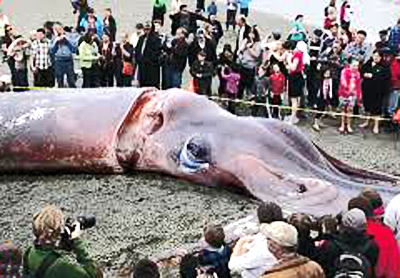
GIANT SQUID
The giant squid remains largely a mystery to scientists despite being the biggest invertebrate on Earth. The largest of these elusive creatures ever found measured 59 feet in length and weighed nearly a ton. Giant squid, along with their cousin, the colossal squid, have the largest eyes in the animal kingdom, measuring some 10 inches in diameter. These massive eyes allow them to see objects in the lightless depths where most other animals would see nothing.

Due to the inhospitable deep-sea habitat where they live, it has been a difficult task to study them. Almost everything scientists know about them is from carcasses that have washed up on beaches or been hauled in by fishermen. However, of late the opportunities for scientists studying these elusive creatures has started to turn. In 2004, researchers in Japan took the first images ever of a live giant squid. And in late 2006, scientists with Japan's National Science Museum caught and brought to the surface a live 24-foot female giant squid.

Sunday, March 31, 2019

Crazy Tax Deductions—Part 2 of 2

Here are some more zany tax deductions that didn't work…and some equally zany ones that did.  And a few deductions where the CPA preparing the taxes offered an opinion before the taxpayer filed the forms.

Here's some that were rejected by the IRS.

1)  Burning Down The Business:
A furniture store owner had unsuccessfully tried for years to sell his business.  He finally hired an arsonist and collected $500,000 in insurance money.  But things went bad for him when he tried to deduct the $10,000 he paid the arsonist as a "consulting fee."  Both men ended up in prison.

2)  Did She Tango Her Way Home:
A taxpayer was denied a deduction for dance lessons which she claimed would improve her varicose veins.  The reason for the rejection?  The IRS claimed the lessons were not medically necessary, the ruling also extending to dance lessons for arthritis and nervous disorders.

3)  Fido's Babysitting:
Millions of household dogs in the U.S. are left home alone each day.  One taxpayer hired someone to come to his house and watch his dog while he was at work then he tried to deduct the expense using the same rules intended for children and legal dependents.  The IRS said 'no way.'

4)  Beer vs. Whiskey:
Here's one that got a thumbs up and a thumbs down.

A gas station owner gave his customers free beer and took the cost as a tax deduction.  On the other hand, a businessman tried to deduct several cases of whiskey he gave to clients as an entertainment expense.  Tax Court ruled that the beer deduction was allowed but the whiskey deduction was denied.  [Makes no sense to me, or anyone else for that matter other than the Tax Court judge who made the ruling]

And here are some surprise rulings in favor of the taxpayer.

5)  Dairy Cows On Safari:
The owners of a dairy farm tried to write off an African safari as a business expense claiming that some of the dairy's promotional efforts included wild animals.  Even though the concept of 'wild dairy cows' is a bit far-fetched, the IRS actually allowed the deduction.

6)  Come By For A Swim:
An emphysema patient was told by his doctor that he needed to start exercising.  So, the patient installed a swimming pool at his home and deducted it as a 'necessary medical expense.'  Even though they turned down the deduction for the tango lessons, the IRS allowed the swimming pool deduction including the cost of various chemicals, cleaning, heating and upkeep.

7)  Here, Kitty-Kitty-Kitty:
Junkyard owners had a nasty snake and rat problem.  In an attempt to combat it, they set out bowls of pet food each night to attract the feral cats that roamed the area.  The cats ate the pet food and also the snakes and rats.  Since the cats made the business safer for customers and employees, the IRS allowed the deduction for the pet food.

8)  The Bigger…The Better:
An exotic dancer wrote off the cost of breast implants, claiming it was a business expense since bigger breasts equaled bigger tips.  The IRS agreed, saying the implants were a stage prop essential to her act.

And finally, some strange deductions the tax preparer ruled on before the taxpayer filed the forms with the IRS.

9)  Carrier Pigeons:
A tax payer was so distrustful of technology that he wouldn't use a computer or even a phone.  So, he used carrier pigeons to communicate with his business partner across town.  He also thought it made sense to deduct all his expenses for the care, feeding, and housing of the carrier pigeons as a business expense.  After determining that the businessman had not used technology for communication in the past, the CPA preparing his taxes decided the deduction was fair.  No word yet on whether the IRS agreed.

10)  A Baby:
A businesswoman tried to deduct the cost of her own baby as a business expense.  She used photos of the baby in marketing materials for her business and believed the money she spent on her baby's food, clothing, nanny, diapers and baby powder—a total of about $26,000 for the year—should all count as business expenses.  The CPA doing her taxes wrote off the cost of hiring the photographer who took the photos of the baby as well as the baby's stroller and clothing items that carried the company logo which pictured the baby, but she informed her client that the rest of the expenses were not allowed.

11)  Hip Replacement For A Dog:
A woman dropped off her tax information to her tax preparer.  He noticed an unusually high amount for medical expenses including $8,000 for a 'family dependent' even though she had no spouse or children.  The family dependent turned out to be her dog.  Because the animal wasn't a medical necessity for the taxpayer, he couldn't let her deduct the cost of the surgery or any of the dog's other expenses.

12)  Pole Dancing Lessons:
A man tried to write off the cost of his wife's pole dancing lessons as a business expense under 'meals and entertainment.'  The man claimed watching her dance was his after work relaxation and made him better at his job.  His tax preparer informed him that the IRS would swiftly deny the $800 deduction.

13)  $1,000 Worth Of Evian Water:
A very wealthy woman convinced her doctor to give her a prescription for three bottles of Evian water (specifying the brand) every day and declared $1,095 as a medical deduction on her taxes for the water.  Her CPA said that since she still had the prescription note in her files showing it had been prescribed by a doctor it was a permissible expense even though the doctor's note didn't disclose what her medical condition was that required three bottles of Evian water every day.

14)  Spanx Shapewear:
A real estate agent who was 'a little bit big on the bottom' (according to her tax preparer) bought several pairs of the Spanx brand slimming underwear because she thought looking smaller would help her sell more houses.  Her tax preparer told her there was no proof the Spanx had any impact on her business or income, therefore, it couldn't be considered a legitimate business expense.

15)  Recreational Drugs:
One financial planner had a rock band client actually try to deduct an item labeled 'drugs' as a Travel & Entertainment expense.  The total cost of the 'drugs' was in the high five-figures.  The band's bookkeeper claimed the cost of recreational drugs was necessary and ordinary.  Setting aside the fact that possession of the recreational drugs was illegal, the tax preparer advised the band that the IRS would never allow the deduction.

And on that note…Happy Tax Day to everyone!

Sunday, March 24, 2019

Crazy Tax Deductions That Didn't Work—Part 1 of 2

It's that time of year again…at least here in the U.S.  Deadline for filing 2018 taxes is Monday, April 15, 2019!

Each year tax payers have tried to take the craziest deductions and have even pursued the matter in tax court where the IRS denied the deductions.  However, with the new tax laws in effect for filing your 2018 taxes, some things have changed.  But, prior to the current filing of 2018 taxes, here are ten of the zanier deduction attempts.

1)  Overdone Overdrafts:
A couple trying to keep their dry-cleaning businesses from going under had been denied business loans by their bank who had judged them to be a bad credit risk.  They came up with a plan to ease their cash flow problems.  They regularly overdrew their bank account and would pay the overdraft when the bank called.  This ended up costing them more than $30,000 a year in overdraft charges which they deducted from their taxes as a business expense.  The Tax Court denied the write-off, stating that the charges were unreasonably high.

2)  Red Blood Cell Depletion Allowance:
Because of her rare blood type, a woman made more than $7,000 in one year as a blood plasma donor.  She tried to offset the additional income through a tax deduction, claiming a depletion for the loss of both her blood's mineral content and her blood's ability to regenerate.  Depletion is a proper write-off for firms that remove deposits of minerals such as coal and iron ore from the ground.  The Tax Court ruled that individuals cannot claim depletion on their bodies.

3)  Prostitutes And Porn:
A tax lawyer spent more than $65,000 a year on prostitutes and pornographic materials which he deducted as a medical expense.  He stated the positive health effects of sex therapy.  The Tax Court denied the write-off saying his conduct was illegal and also wasn't the treatment for a medical condition.

4)  Burning Down The House:
A man relocated his family to a new state after a job transfer.  His wife didn't like the new location and returned home with the kids.  He visited over a holiday weekend and discovered another man had been living with her.  They argued and she left the house at which time he put some of her clothes on the stove and set them on fire.  It got out of control and burned the house down.  He claimed a casualty loss deduction and the Tax Court denied it saying they could not allow him to deduct a loss from a fire he set.

5)  Hush Money:
A pro football player got into an altercation with a lady friend at the time that he was in the process of negotiating a contract extension.  She filed a criminal complaint against him.  The team owner said if the matter became public, they would cut or trade him.  He agreed to pay her $25,000 to keep things quiet and he got his four-year contract extension.  When he tried to take the payout as a tax deduction, the Tax Court said the payment was a result of a personal relationship rather than a business expense.

6)  Designer Clothes:
The manager of a designer label boutique was required to purchase and wear the designer's clothing as a condition of her job to project the image of an exclusive life style.  A court denied her deduction because the clothes could be worn outside work regardless of the fact that they were not her personal taste of clothing. [Several decades ago when Dinah Shore had her weekly television variety show, she deducted several gowns she had worn on her show as a business expense. The IRS claimed they weren't business as she could wear them to social functions having nothing to do with her television show. Her counter argument was that they were not useable for anything else as she could not even sit down in them. The IRS had her put on each of the gowns and prove that she couldn't sit down. She couldn't sit in them and the IRS relented.]

7)  Las Vegas Gambling Junket:
A repo company sponsored a bus trip to Las Vegas in an effort to drum up business from banks.  The people talked informally about the collection business, but everyone spent most of the weekend gambling and no formal meetings were scheduled.  The trip was very successful and the repo company got a lot more business from the attendees.  However, the Tax Court denied them the deduction of the cost of the junket because the business discussions were only a small part of the trip.

8)  Meals With Colleagues:
A partner in a law firm met every day with his colleagues at lunch to discuss the firm's business.  Unfortunately, the IRS denied the deduction for the meals as being a business expense.  The law firm took it to Tax Court where the court agreed with the IRS that the meals were a non-deductible personal expense.

9)  Wrecking A Rental Car:
Heavy fog had an airline employee stranded who needed to get to New Orleans.  He worked out a deal with a rental car company to take one of their cars that they needed driven to New Orleans.  The company would have the car transported without having to pay a driver and he would get to New Orleans with no charge for the rental car.  Unfortunately, he wrecked the car in Mississippi and had to pay for damages.  When he tried to deduct the payment as a casualty loss, the Tax Court denied the deduction because he wasn't the owner of the car.

10)  Shoddy Construction:
A couple paid a builder to construct their home.  Shortly after they moved in, they found a series of problems with the house that made living there impossible.  They deducted a large theft loss on their taxes, claiming the builder defrauded them.  The Tax Court denied it stating they were the victims of poor workmanship rather than fraud.

Next week in Part 2, I'll be sharing some more strange deductions that didn't work along with some equally weird deductions that the IRS actually accepted.

Sunday, March 17, 2019

24 Historical Quotes That Proved To Be Very Wrong

There are the statements made, then there is the reality that follows.  Here is a list of 24 historical quotes probably believed when they were first spoken but have since been proven to be very wrong.

24)  "There is not the slightest indication that nuclear energy will ever be obtainable.  It would mean that the atom would have to be shattered at will."
  --Albert Einstein, 1932
23)  "We don't like their sound, and guitar music is on the way out."
  --Decca Recording Company on declining to sign the Beatles, 1962

22)  "This 'telephone' has too many shortcomings to be seriously considered as a means of communication.  The device is inherently of no value to us."
  --Western Union internal memo, 1876

21)  "Reagan doesn't have that presidential look."
  --United Artists executive after rejecting Reagan as lead in the 1964 film THE BEST MAN.
 
20)  "Train travel at high speed is not possible because passengers, unable to breathe, would die of asphyxia."
  --Dr. Dionysius Lardner, 1830

19)  "I think there is a world market for maybe five computers."
  --Thomas Watson, chairman of IBM, 1943

18)  "X-rays will prove to be a hoax."
  --Lord Kelvin, President of the Royal Society, 1883

17)  "Everyone acquainted with the subject will recognize it as a conspicuous failure."
  --Henry Morton, president of the Stevens Institute of Technology, on Edison's light bulb, 1880

16)  The horse is here to stay but the automobile is only a novelty—a fad."
  --The president of the Michigan Savings Bank advising Henry Ford's lawyer not to invest in the Ford Motor Co., 1903
15)  "Television won't last because people will soon get tired of staring at a plywood box every night."
  --Darryl Zanuck, movie producer, 20th Century Fox, 1946

14)  "No one will pay good money to get from Berlin to Potsdam in one hour when he can ride his horse there in one day for free."
  --King William I of Prussia on trains in 1864

13)  "There is no reason for any individual to have a computer in his home."
  --Ken Olson, president, chairman and founder of Digital Equipment Corporation (DEC), in a talk given to a 1977 World Future Society meeting in Boston

12)  "If excessive smoking actually plays a role in the production of lung cancer, it seems to be a minor one."
  --W.C. Heuper, National Cancer Institute, 1954

11)  "No, it will make war impossible."
  --Hiram Maxim, inventor of the machine gun, in response to the question "Will this gun not make war more terrible?" asked by Havelock Ellis, an English scientist, 1893

10)  "The wireless music box has no imaginable commercial value.  Who would pay for a message sent to no one in particular?"
  --Associates of David Sarnoff responding to the latter's call for investment in the radio in 1921
9)  "There will never be a bigger plane built."
  --A Boeing engineer after the first flight of the 247, a twin engine plane that held ten people

8)  "How, sir, would you make a ship sail against the wind and currents by lighting a bonfire under her deck?  I pray you, excuse me, I have not the time to listen to such nonsense."
  --Napoleon Bonaparte, when told of Robert Fulton's steamboat, 1800s

7)  "The idea that cavalry will be replaced by these iron coaches is absurd.  It is little short of treasonous."
  --Comment of Aide-de-camp to Field Marshal Haig, at tank demonstration 1916

6)  "I must confess that my imagination refuses to see any sort of submarine doing anything but suffocating its crew and floundering at sea."
  --HG Wells, British novelist, in 1901

5)  "The world potential market for copying machines is 5000 at most."
  --IBM, to the eventual founders of Xerox, saying the photocopier had no market large enough to justify production, 1959

4)  "It'll be gone by June."
  --Variety Magazine on Rock n' Roll, 1955

3)  "And for the tourist who really wants to get away from it all, safaris in Vietnam."
  --Newsweek, predicting popular holidays for the late 1960s 
2)  "When the Paris Exhibition [of 1878] closes, electric light will close with it and no more will be heard of it."
  --Oxford professor Erasmus Wilson

1)  "A rocket will never be able to leave the Earth's atmosphere."
  --New York Times, 1936

Right now, somewhere in the world, there is a prominent person making a statement about some new emerging innovation that will give future generations a good chuckle.