Sunday, April 17, 2022

6 Important Lands That Never Existed

This week's blog is about six lands at one time believed to be real but since have been proven to be no more than myths.

Ancient travelers (and by ancient I mean many centuries ago, maybe even millenniums) told stories of mysterious places located in the unexplored reaches of the world—fabled cities, phantom islands, and exotic civilizations.  Even though these lands were usually dismissed as myths and legends, a few of them found their way onto world maps and helped inspire some of history’s most important journeys of discovery.  From a fabled Christian empire in Asia to a supposed lost kingdom in Canada, find out more about six of the most influential lands that never were.
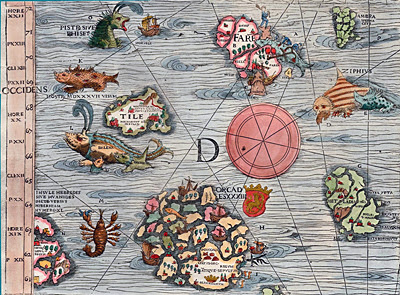
1) Thule

A subject of fascination for ancient explorers, romantic poets and Nazi occultists.  Thule was an elusive territory believed to be located in the frozen north Atlantic near Scandinavia. Its legend dates back to the 4th century B.C. when the Greek journeyman Pytheas claimed to have travelled to an icy island beyond Scotland where the sun rarely set and land, sea and air combined into a bewildering, jelly-like mass.

Many of Pytheas' contemporaries doubted his claims, but that didn't stop distant Thule from lingering in the European imagination.  It eventually became synonymous with the northernmost place in the known world.  Explorers and researchers variously identified it as Norway, Iceland and the Shetland Islands, and it served a recurring theme in poetry and myth.  The island is perhaps most famous for its connection to the Thule Society, a post-World War I occult organization in Germany that considered Thule the ancestral home of the Aryan race. The Munich-based group counted many future Nazis among its members, including Rudolf Hess, who later served as Deputy Führer of Germany under Adolf Hitler.

2) The Kingdom of Prester John

For more than 500 years, Europeans believed a Christian king ruled over a vast empire somewhere in the wilds of either Africa, India or the Far East.  Talk of this mythical land first surfaced in 1165 after the Byzantine and Holy Roman emperors received a letter—most likely a European forgery—from a monarch calling himself Prester John.  The mysterious king claimed to serve as supreme ruler of the three Indies and all its 72 kingdoms.  He described his realm as a utopia rich in gold, populated by exotic races of giants and horned men.  Perhaps most important of all, Prester John and his subjects were Christians—even the name Prester meant Priest.

Despite the fact that a Papal mission to find Prester John's court disappeared without a trace, the myth of his kingdom took hold among Europeans.  Crusading Christians rejoiced in the idea that a devout ruler might come to their aid in the struggle against Islam during the Crusades, and when Genghis Khan's Mongol hordes conquered parts of Persia in the early 1200s, many mistakenly credited Prester John's forces with the attack.  The kingdom later became a subject of fascination for travelers and explorers.  Marco Polo provided a questionable account of encountering its remnants in Northern China.  Vasco da Gama and other Portuguese mariners searched for it in Africa and India.  While explorers eventually discovered a Christian civilization in Ethiopia, it lacked the grandeur and the gold Europeans had come to associate with Prester John's realm. By the 17th century, the legend had faded, and the famed empire was dropped from most maps.

3) Hy-Brasil

Long before Europeans ever stepped foot in the New World, explorers searched for the island of Hy-Brasil, an ethereal land said to exist off the west coast of Ireland.  The story of Hy-Brasil most likely comes from Celtic legend—its name means Isle of the Blest in Gaelic—but its precise origins are unclear.  Hy-Brasil first appeared on maps in the 14th century, usually in the form of a small, circular island with a narrow strait splitting it in two.  Many mariners accepted it as a real place until as recently as the 1800s, and it became popular as the basis for myths and folktales.  Some legends described the island as a lost paradise.  Others claimed that it was perpetually obscured by a dense curtain of mist and fog, only becoming visible to the naked eye every seven years.  [which sounds as if it might have been the genesis of the Lerner & Lowe musical Brigadoon about a village in Scotland that appeared out of the mist every one hundred years]

Despite its somewhat whimsical reputation, Hy-Brasil was widely sought after by Britain-based explorers in the 15th century. The navigator John Cabot launched several expeditions in an attempt to find it.  It's suggested that he had hoped to locate it during his famous journey to the coast of Newfoundland in 1497.  Documents from Cabot's time claim that previous explorers had already reached Hy-Brasil, leading some researchers to argue that these unnamed mariners may have inadvertently traveled all the way to the Americas prior to Christopher Columbus.

4) El Dorado

Beginning in the 16th century, European explorers and conquistadors were intrigued by tales of a mythical city of gold located in the unexplored reaches of South America.  The city had its origin in accounts of El Dorado (The Gilded One), a native king who powdered his body with gold dust and tossed jewels and gold into a sacred lake as part of a coronation rite.  Stories of the gilded king eventually led to rumors of a golden city of untold wealth and splendor.  Adventurers spent many years—and countless lives—in a futile search for its riches.

One of the most famous El Dorado expeditions came in 1617, when the English explorer Sir Walter Raleigh traveled up the Orinoco River on a quest to find it in what is now Venezuela.  They didn't find any trace of the gilded city, and King James I later executed Raleigh after he disobeyed an order to avoid fighting with the Spanish.  El Dorado continued to drive exploration and colonial violence until the early 1800s, when scientists Alexander von Humboldt and Aimé Bonpland branded the city a myth after undertaking a research expedition to Latin America.

El Dorado wasn't the only gilded city supposedly tucked away in the New World.  European explorers also hunted for the Seven Cities of Cibola, a mythical group of gold-rich settlements said to be located somewhere in what are now Mexico and the American Southwest.  The most famous search for the Seven Cities came in the 16th century, when the Spanish conquistador Francisco Vasquez de Coronado scoured the Great Plains of the U.S. in search of a city of riches called Quivira.

5) St. Brendan's Island

St. Brendan's Island was a mysterious manifestation of Paradise once thought to be hidden somewhere in the eastern Atlantic Ocean.  The myth of the phantom island dates back to the Navigation Brendani, or Voyage of Brendan, a 1,200-year-old Irish legend about the seafaring monk St. Brendan the Navigator.  As the story goes, Brendan led a crew of pious sailors on a 6th century voyage in search of the famed Promised Land of the Saints.  The journey on the open sea describes attacks by fireball-wielding giants and run-ins with talking birds.  According to the tale, Brendan and his men landed on a mist-covered island filled with delicious fruit and sparkling gems. The grateful crew are said to have spent 40 days exploring the island before returning to Ireland.

Although there is no historical proof of St. Brendan's voyage, the legend became so popular during medieval times that St. Brendan's Island found its way onto many maps of the Atlantic. Early cartographers placed it near Ireland, but in later years it migrated to the coasts of North Africa, the Canary Islands and finally the Azores. Sailors often claimed to have caught fleeting glimpses of the mystical isle during the Age of Discovery, and it's likely that even Christopher Columbus believed in its existence.  Its legend eventually faded after multiple search expeditions failed to track it down. By the 18th century, the famed Promised Land of the Saints had been removed from most navigational charts.

6) The Kingdom of Saguenay

The story of the mirage-like Kingdom of Saguenay dates to the 1530s, when French explorer Jacques Cartier made his second journey to Canada in search of gold and a northwest passage to Asia.  While traveling along the St. Lawrence River at what is modern day Quebec, Cartier's Iroquois guides began to whisper tales of Saguenay, a vast kingdom that lay to the north. According to a chief named Donnacona, the mysterious realm was rich in spices, furs and precious metals and populated by blond, bearded men with pale skin.  The stories eventually transitioned into the realm of the absurd when the natives claimed the region was also home to races of one-legged people and whole tribes possessing no anus.  Cartier became intrigued by the prospect of plundering the riches of Saguenay.  He brought Donnacona back to France, where the Iroquois chief continued to spread tales of a lost kingdom.

Legends about Saguenay haunted French explorers in North America for years, but treasure hunters never found any trace of the mythical land.  Most historians now dismiss it as a myth, but some argue the natives may have been referring to copper deposits in the Canadian northwest.  Others have suggested that the Indian tales could have been inspired by a centuries old Norse outpost left over from Viking voyages to North America.

Fortunately, today we have Google Earth to confirm or deny such rumors of mythical places.  :)

Sunday, April 10, 2022

Famous Historical People And Their Favorite Food (part 2 of 2)

Which world leader's favorite food was the simple grilled cheese sandwich? Which Hollywood star earnestly yearned for a plate of beef tripe? This week in part 2 of 2, I'm presenting the favorite food of famous historical people who achieved fame and/or notoriety after 1900.

Albert Einstein

A 2014 article in Time magazine reported that frequent fish-eaters had increased brain power. If that's true, then Albert Einstein, one of the smartest people who ever lived, probably ate fish for breakfast, lunch, and dinner. But in reality, he didn't. In fact, his favorite dish was distinctly unfishy—it was pasta. If he came to your house for dinner, you could make him happy with a heaping plate of spaghetti.

Alfred Hitchcock

Master film director Alfred Hitchcock seemed like the kind of man who enjoyed his food. And his favorite meal? Ham pie. It actually sounds pretty tasty with ingredients including nutmeg, cayenne pepper, and eggs. Strangely, he'd eat eggs cooked in a dish but individual eggs completely horrified him. He claimed to be terrified by the sight of the yellow yolk leaking out.

Andy Warhol

Given some of Warhol's most famous artworks, you might assume his favorite meal would be a can of Campbell's tomato soup. He claimed he had it for lunch every day for 20 years. Yet it wasn't his number one food. That honor went to cake, just about any kind of cake. One story said he had his own unique recipe—a chocolate bar stuffed in between two slices of bread.

Benito Mussolini

To say that Italy's fascist dictator Benito Mussolini had little to recommend him as a human being is putting it mildly. And not surprisingly, his eating habits also left a lot to be desired. Apparently, his favorite snack was a salad garnished with lots of raw garlic. It must have been possible to smell him approaching before he entered a room.

Charlie Chaplin

Sir Charles Spencer Chaplin, perhaps the most famous movie actor of his era and still highly popular today, loved to eat something seldom seen on today's menu—beef tripe. It's so rarely served nowadays, you might not even be sure what it is. It's the stomach lining of an animal, usually pig, sheep, or, as in Chaplin's case, cow.

Elvis Presley

Elvis famously struggled with his weight in later years, and when you take a look at his favorite food, that comes as no surprise. The King's number one snack was a fried peanut butter and banana sandwich. Basically, you make this calorie-heavy dish by spreading mashed banana and peanut butter between two slices of white bread. But the killer blow is that you fry it in two tablespoons of butter.

Ernest Hemingway

American literary giant Ernest Hemingway spent a considerable amount of time in Europe, especially Paris. That might make you think he would be partial to fancy French cuisine, but he wasn't. When it came to food, Hemingway was as American as apple pie. Or, in his case, hamburgers, as it was those tasty beef patties in a bun that he loved above all other goods.

Frank Sinatra

Frank Sinatra was one of the smoothest crooners of all time. But when he wasn't making us swoon with his voice, he loved nothing more than to eat Italian food. Many say his favorite restaurant was Patsy's Italian in New York City. And when he visited, he was sure to order their artichokes with a stuffing that included Parmesan, olives, capers, and herbs.

Franklin D. Roosevelt

When he wasn't steering America out of the Great Depression or leading the country to World War II victory, it seems that President Franklin D. Roosevelt enjoyed simple things. One of those was his favorite snack—grilled cheese sandwich. And when he wasn't eating that, he enjoyed a plate of scrambled eggs or a hot dog.

Harry Houdini

When he wasn't freeing himself from chains, straitjackets, and even coffins, Harry Houdini kept up his strength with platefuls of spaetzle. For those not sure exactly what spaetzles are, you're in good company. They are actually a type of egg dumpling originating in central Europe. Since Houdini was born in Hungary, spaetzle may have been a favorite from childhood.

Helen Keller

Helen Keller's lack of sight and hearing—caused by an illness in infancy—didn't stop her from becoming a distinguished writer and advocate for disabled people's rights. Bug given her undoubtedly sharp intellect, you might have thought she'd have a sophisticated palate. But not so. Her favorite snack was the reassuringly informal hot dog.

John F. Kennedy

The fact that President John F. Kennedy was born in Brookline, Massachusetts, means that his favorite food should hardly come as a surprise. It was clam chowder, a dish much loved throughout New England. Of course, for a Massachusetts man, the chowder had to be made with plenty of cream in the traditional style of the region.

Kim Jong Il

Kim Jong Il (father to North Korea's current dictator) was the second of the hereditary communist dictators from the Kim dynasty who ruled North Korea until his death in 2011. It's reported that his favorite food was dog meat stew—and no, not a dish made from meat usually served to dogs. It was a stew made with dog [definitely a horrible thought]. Apparently, he liked to wash it down with a disgracefully decadent Western product—Hennessy brandy.

Margaret Thatcher

British prime minister from 1979 to 1990, Margaret Thatcher was unusual among world leaders due to her pre-politics career. A chemistry graduate, she actually worked as a food scientist for a time, and some even claim she developed soft scoop ice cream. But that wasn't her favorite food. Her favorite was a strange concoction called "mystery starter." This was an unlikely mixture of Philadelphia cream cheese, tinned beef consommé, and curry powder.

Pablo Picasso

Spanish artist Pablo Picasso, perhaps the 20th century's most famous painter, was tremendously successful during his lifetime. He could have eaten the fanciest food available in his adopted country of France. But when it came down to it, nothing pleased Picasso more than a plate of Catalan sausages from his native Spain, accompanied by beans.

Sammy Davis, Jr.

Speaking to the Evening Independent in 1966,Sammy Davis, Jr., made it no secret about his favorite food. The talented singer and actor said he loved spaghetti and meatballs. He added that it dated to when he was a child. Even when touring internationally would take him to Rome, Italy, he would always end up ordering spaghetti and meatballs.

Vladimir Lenin

When he wasn't leading and consolidating Russia's communist revolution, ruthless Bolshevik Vladimir Lenin likes to relax with a bowl of his favorite broth. And that was milk soup with dumplings, a dish that many of us may be unfamiliar with. In fact, it sounds more like a drink than a soup since its ingredients were simply milk, salt, and sugar. Although it was fortified with the addition of hearty dumplings.

Winston Churchill

British wartime leader Sir Winston Churchill was well-known for his enjoyment of alcoholic beverages and large cigars. Nothing particularly peculiar about that. But his favorite food is quite a surprise, it was soup. But not just any old soup—it had to be turtle soup. Of course, in today's conservation-conscious era, killing a turtle to make soup is frowned on. 

Sunday, April 3, 2022

Famous Historical People And Their Favorite Food (part 1 of 2)


This week in part 1 of 2, I'm presenting the favorite food of famous historical people who achieved fame and/or notoriety before 1900.

Abraham Lincoln

Abraham Lincoln was a man of straight forward tastes, and one dish in particular whetted his appetite—a simple place of baked beans. During the Civil War, it's said Lincoln would often join his personal guard detachment to share their humble meal of beans.

Alexandre Dumas

Best known for The Three Musketeers, French author Alexandre Dumas was something of a gourmet who ate at the fanciest Paris restaurants. One of his works was an encyclopedia of cooking, the Grand Dictionaire de Cuisine. His favorite food was actually an elaborate salad dressing, which included herbs, boiled eggs, anchovies, and gherkins.

Anne Boleyn

Anne Boleyn—one of six women unlucky enough to marry Henry VIII. It didn't end well for her since Henry had her beheaded for alleged infidelity. But before that fateful day, her favorite meal was apparently venison. When Henry was courting her, it's said one way he tried to win her favor was to gift her with deer meat.

Beethoven

Even though he was a famous composer, Ludwig Van Beethoven seldom had much money to spare. It's not surprising that his favorite food would be the economical mac and cheese. But it wasn't really all that inexpensive, as Beethoven insisted the dish had to be made with Parmesan, not the cheapest of cheeses.

Charles Darwin

British naturalist Charles Darwin shot to fame with the publication of his revolutionary book The Origin of Species. Darwin didn't just study the natural world: he also ate it. While he was a student at Cambridge University in England, he was a member of a group called the Glutton's Club. It was dedicated to eating creatures not normally on human menus. So later in life, it was only natural that he would dine on an armadillo. Apparently, it tasted like duck.

George Washington

When George Washington sat down at the meal table, there was one thing that had to be on hand: mushroom ketchup. When we think of ketchup today, tomatoes immediately come to mind. But back in Washington's day, ketchup was tomato-free. It was made with horseradish, anchovies, and mushrooms.

Grover Cleveland

President Grover Cleveland, in office for two separate terms in the 19th century, was apparently no fan of some of the fancier cuisine served up in the White House. He actually had the misfortune of inheriting a French chef from his predecessor Chester A. Authur, but it seems that what Cleveland really craved was a simple plate of pickled herring.

Henry VIII

In popular belief, Henry VIII ate whole roast chickens with his bare hands, throwing the remains over his shoulder to be tidied up by servants. That's probably a myth. But according to actual history, his favorite food was fruit preserves, otherwise known as jam. And not spread on bread, either. He ate it by itself using a fork.

James Monroe

Founding Father James Monroe, who was also U.S. President from 1817 to 1825, was a native Virginian. Apparently it was in Virginia that his favorite dish originated. Although it's said that Monroe was no stranger to more elaborate French cuisine, he turned to spoon break—similar to break pudding—for comfort. It's commonly thought that this dish tasted best when eaten right from the pan where it was cooked.

Julius Caesar

When he found time between conquering large parts of the known world and running the Roman Empire, there was one dish he craved—asparagus. But it had to be served just right. According to The National Geographic, apparently the Roman emperor was once served asparagus prepared in myrrh. The only way to serve it was with olive oil.

Leonardo da Vinci

Renaissance genius Leonardo da Vinci lived for many years in Tuscany, and it was this Italian region that was responsible for his preferred dish: minestrone soup. Some historians believe the great master was actually a vegetarian in his later years. He seems to have thrived on his favorite minestrone soup since he lived to be 67, a very old age in medieval times.

Mark Twain

Literary giant and accomplished humorist, Mark Twain was in little doubt about his favorite food. At one point, he sat down and made a list of all the foods he missed during his foreign travels. Oysters prepared in various ways appeared no fewer than five times. He was partial to them fried, roasted, stewed, in soup, or simply on the half shell. Obviously, Twain loved oysters.

Mary Shelley

English author Mary Shelley is primarily known for just one of her books, her 1818 work, Frankenstein.  She obviously had a vivid imagination. But when it came to food, she was a bit of a plain Jane. Her heart's desire was simple kale.

Mozart

The 18th century Austrian composer Wolfgang Mozart produced an astonishing amount of truly beautiful music. But when he wasn't hard at work creating those heavenly melodies, he appetite was more earth bound. His favorite dinner was liver dumplings accompanied by sauerkraut.

Napoleon

Napoleon Bonaparte could presumably have had any dish he wanted from across his extensive empire. But appropriately enough for this military mastermind, the recipe he loved best was actually created on the battlefield. He defeated the Austrians at the Battle of Marengo in 1800. As well as a battlefield victory, the conflict yielded Chicken Marengo. Napoleon's favorite dish. It's a stew with eggs, crawfish, tomatoes, and herbs added to chicken.

Oscar Wilde

Flamboyant British literary figure and legendary wit Oscar Wilde is said to have been a man who enjoyed his meals, and one of his favorite dishes was roast duck. But for Wilde, the duck had to be an actual wild bird, not a farmyard bred fowl. The probably meant he ate mallard ducks, the most popular wild breed eaten in the U.K. to this day.

Queen Elizabeth I

Elizabeth I—on the English throne for 70 years until her death in 1603—is said to have dined on roast cygnet for Christmas dinner. Eating swan was a sign of high status during the Middle Ages, so it was a dish truly fit for a queen. But apparently swans are best eaten as juveniles, when they're called cygnets. According to chef and author Hand Shaw, mature swans taste like "fishy mutton."

Queen Victoria

Presumably, Queen Victoria could have snapped her fingers and ordered any dish available in the sprawling British Empire of the19th century, so her favorite food comes as a genuine surprise: the humble potato. Evidence comes from an anonymously authored 1901 publication, The Private Life of the Queen by a Member of the Royal Household. The writer made the startling claim that, "Her Majesty confesses to a great weakness for potatoes, which are cooked for her in every conceivable way."

Thomas Jefferson

Thomas Jefferson is best remembered for his two presidential terms at the beginning of the 19th century, but he also spent five years as the U.S. Minister to France. And when he returned to America, he brought with him some of his favorite foods. Notable among those was French fried. So, as well as his formidable political achievements, Jefferson can take credit for a dish that has become a central staple of the American diet.

William Henry Harrison

William Henry Harrison served as President of the United States for a mere 32 days in 1841 before he was struck down by a severe case of pneumonia. That made him the shortest term White House occupant in history. We don't know if he was the only president who often dined on squirrel, but the bushy tailed rodent cooked in a stew was his favorite dish.

Zachary Taylor

Zachary Taylor occupied the White House for only 16 months before his premature death in 1850. Although he was a native of Virginia, apparently he was a big fan of Creole cuisine. His favorite snack was calas, a sugary fried-dough treat similar to beignets.

Next week, in part 2, I'll be sharing the favorite food of famous historical people who achieved fame between 1900 and present.

Sunday, March 27, 2022

April Fools' Day

Friday, April 1, 2022—April Fools' Day or All Fools' Day as it is also known.  A date that has been celebrated for centuries.  But what in the world could possibly be the origins of a day dedicated to pranks and practical jokes?

The exact origins remain a bit of a mystery, the most widely accepted theory says it dates back to 1582 when France switched from the Julian calendar where the new year began on April 1 to the Gregorian calendar where the new year began on January 1 as called for in 1563 by the Council of Trent.  People who didn't get the word that the start of the year had moved or refused to accept the change and continued to celebrate it during the last week of March through April 1 became the object of jokes and hoaxes.  Paper fish would be placed on their backs and they were referred to as poisson d'avri which means April fish.  It symbolized a young, easily caught fish and a gullible person.  These people were considered fools and had practical jokes played on them.

Historians have linked April Fools' Day to ancient festivals such as Hilaria, which was celebrated in Rome at the end of March and involved people dressing up in disguises.  There's also speculation that April Fools' Day was tied to the vernal equinox in the Northern Hemisphere, a time when Mother Nature fooled people with changing and unpredictable weather.

On April 1, 1700, English pranksters began popularizing the annual tradition of April Fools' Day by playing practical jokes on each other.  The celebration spread throughout Britain during the eighteenth century.  In Scotland it became a two day event in which people were sent on phony errands and had fake tails or kick me signs pinned to their rear ends.

All Fools' Day is practiced in many parts of the world with the playing of practical jokes and sending people on fool's errands.  In modern times, people have gone to great lengths to stage elaborate pranks.  Here's the top ten hoaxes from a list of the best one hundred pranks of all time as judged by notoriety, creativity, and number of people duped.

1)  The Swiss Spaghetti Harvest (1957):  The respected BBC news show Panorama announced that thanks to a very mild winter and the virtual elimination of the dreaded spaghetti weevil, Swiss farmers were enjoying a bumper spaghetti crop.

2)  Sidd Finch (1985):  Sports Illustrated published a story about a new rookie pitcher who planned to play for the Mets.  His name was Sidd Finch, and he could reportedly throw a baseball at 168 mph with pinpoint accuracy.  But Sidd Finch had never played the game before.  He mastered the art of the pitch in a Tibetan monastery.  This legendary player was the creation of the article's author, George Plimpton.

3)  Instant Color TV (1962):  At the time there was only one television channel in Sweden, and it broadcast in black and white.  The station's technical expert, Kjell Stensson, appeared on the news to announce that, thanks to a new technology, viewers could convert their existing sets to display color reception.  All they had to do was pull a nylon stocking over their television screen.

4)  The Taco Liberty Bell (1996):  The Taco Bell Corporation announced it had purchased the Liberty Bell and was renaming it the Taco Liberty Bell.  Outraged citizens called the National Historic Park in Philadelphia to express their anger.

5)  San Serriffe (1977):  British newspaper The Guardian published a special seven-page supplement devoted to San Serriffe, a small republic consisting of semi-colon shaped islands located in the Indian Ocean.  It described the geography and culture of this obscure nation.  Its two main islands were named Upper Caisse and Lower Caisse.  Its leader was General Pica.  Only a few readers noticed that everything about the islands was named after printer's terminology.

6)  Nixon for President (1992):  National Public Radio's Talk of the Nation program announced that Richard Nixon, in a surprise move, was running for President again.  His campaign slogan was, "I didn't do anything wrong, and I won't do it again."  Listeners flooded the show with calls expressing shock and outrage.  Nixon's voice was impersonated by comedian Rich Little.

7)  Alabama Changes the Value of Pi (1998):  The April 1998 issue of the New Mexicans for Science and Reason newsletter contained an article claiming that the Alabama state legislature had voted to change the value of the mathematical constant pi from 3.14159 to the Biblical value of 3.0.  The article soon made its way onto the internet, then rapidly spread around the world.  The Alabama legislature began receiving hundreds of calls from people protesting the legislation.  The original article was intended as a parody of legislative attempts to circumscribe the teaching of evolution and had been written by a physicist.

8)  The Left-Handed Whopper (1998):  Burger King published a full page ad in USA Today announcing the introduction on their menu of a Left-Handed Whopper for the 32 million left-handed Americans.  The ingredients were the same as the original Whopper, but the ad claimed all the condiments were rotated 180 degrees for the benefit of their left-handed customers.  Thousands of customers requested the new sandwich.

9)  Hotheaded Naked Ice Borers (1995):  Discover Magazine reported that a highly respected wildlife biologist found a new species in Antarctica—the hotheaded naked ice borer.  The creatures had bony plates on their heads.  When fed by numerous blood vessels, they could become burning hot thus allowing the animals to bore through ice at high speeds.  They used this ability to hunt penguins, melting the ice beneath the penguins and causing them to sink downwards where the hotheads consumed them.  It was theorized that the hotheads might have been responsible for the mysterious disappearance of noted Antarctic explorer Philippe Poisson in 1837.  To the hotheads, the explorer looked like a penguin.

10)  Planetary Alignment Decreases Gravity (1976):  British astronomer Patrick Moore announced on BBC Radio 2 that at 9:47AM a once-in-a-lifetime astronomical event was going to occur and listeners could experience it in their own homes.  Pluto would pass behind Jupiter, temporarily causing a gravitational alignment that would counteract and lessen the Earth's own gravity.  Moore told his listeners that if they jumped in the air at the exact moment the planetary alignment occurred they would experience a strange floating sensation.  When 9:47AM arrived, BBC2 began to receive hundreds of phone calls from listeners claiming to have felt the sensation.  One woman reported she and her eleven friends had floated around the room.

Have you ever played an April Fools' joke on someone, or had one played on you?  Tell us about it. 

Sunday, March 20, 2022

10 BIGGEST BRAND FEUDS

Companies have been suing each other for ages, especially over copyright infringement.  Some of the biggest brands in the world have taken each other to court.  The outcome of some of these lawsuits have altered entire industries some of which might look very different today if the outcome of the lawsuit had gone the other way.

10)  DYSON VS. HOOVER (2000)

Duration of lawsuit:  one year

Winner:  Dyson

Damages:  $4.9 million

Dyson claimed Hoover infringed on its patent for the bagless cleaner which uses a dynamic similar to a centrifuge to pull dust from the air.  The court found that Hoover used the same technology which did infringe on James Dyson's invention.  Hoover appealed twice and lost both times.  The court instructed Hoover to stop selling its Vortex model.

9)  ORACLE VS. SAP (2007)

Duration of lawsuit:  seven years

Winner:  Oracle

Damages:  $357 million

Center of the lawsuit was SAP's TomorrowNow unit which Oracle claimed had illegally downloaded copyrighted documents and programs from Oracle.  SAP admitted it had infringed on copyright and tried to settle out of court before a jury awarded Oracle $1.3 billion in damages, an amount later brought down to $357 million. Both sides accepted the lower amount.

8)  20TH CENTURY FOX VS. UNIVERSAL STUDIOS (1978)

Duration of lawsuit:  two years

Winner:  Universal Studios

Damages:  Unknown

After 20th Century Fox successfully released the first Star Wars movie in 1977, Universal Studios decided it needed a space epic of its own and launched Battlestar Galactica.  Fox accused Universal of copyright infringement, citing 34 specific things allegedly copied.  The case was settled out of court.  ABC television network, where Battlestar Galactica aired, canceled the show in 1979.  [I worked for 20th Century Fox during this time and the series I was working on used material from Star Wars.  The Fox legal department kept a very close eye on how we were using the film footage to make sure it didn't give any ammunition to Universal for the lawsuit.]

7)  GUCCI VS. GUESS (2009)

Duration of lawsuit:  four years

Winner:  Gucci…and Guess

Damages:  $4.6 million

In 2009 Gucci started a four-year-long legal battle, accusing Guess of copying Gucci's logo on a line of shoes.  They also accused Guess of counterfeiting, unfair competition, and trademark infringement.  They demanded $221 million in damages. Gucci filed two lawsuits, one in New York and the other one in Milan, Italy.  The New York case was closed in favor of Gucci and they were awarded $4.7 million in damages.  The Milan court ruled in favor of Guess, stating the use of the "G" was common in the fashion industry.

6)  APPLE VS. MICROSOFT (1998)

Duration of lawsuit:  six years

Winner:  Microsoft

Damages:  Unknown

Apple licensed parts of their Macintosh computer to Microsoft for its Windows 1.0 software.  When Microsoft released Windows 2.0, it added other features, including overlapping windows, which could also be found in the Macintosh's software.  Apple filed a lawsuit claiming copyright infringement and listed 189 parts of the interface that had been copied.  After six years, the court dismissed 179 of Apple's claims and said the remaining ten in dispute could not be copyrighted.

5)  A&M RECORDS VS. NAPSTER (2010)

Duration of lawsuit:  five years

Winner:  A&M Records

Damages:  $26 million

Napster originally launched as a pirated music marketplace, allowing anybody to download music for free.  Music labels didn't wait long to sue.  Even though the plaintiff was referred to as A&M Records, it actually included all members of the Recording Industry Association of America.  After the case was concluded, Napster was forced to shut down.  The brand was later acquired by the software company Roxio and relaunched as a legal music store, but it eventually died.

4)  MICROSOFT VS. MOTOROLA (2010)

Duration of lawsuit:  five years

Winner:  Microsoft

Damages:  $14.5 million

Microsoft accused Motorola of charging excessively to license its patented technologies.  Motorola was charging a 2.25% royalty amounting to $4 billion.  The court decided it wasn't fair and reasonable, fined Motorola, and ordered them to pay Microsoft $14.5 million for breach of contract.

3)  BP VS. TRANSOCEAN OFFSHORE AND HALLIBURTON (2010)

Duration of lawsuit:  five years

Winner:  Settled out of court

Damages:  Unknown

After the Deepwater Horizon  oil spill that killed eleven workers and polluted the Gulf of Mexico with millions of barrels of oil, BP was levied with fines and clean-up costs running into $40 billion.  BP believed their partners at the time of the spill, Transocean Offshore and Halliburton, should share the costs of the fines and demanded $15 billion.  The companies settled in 2015 in a series of legal deals.

2)  APPLE VS. SAMSUNG (2011)

Duration of lawsuit:  Ongoing since 2012

Winner:  not yet determined

Damages:  not yet determined

This lawsuit is one of the biggest in the technology industry.  It goes back to the first iPhone which Apple accused Samsung of copying for its Galaxy 5 series.  A jury in 2012 decided that Samsung had infringed on Apple's patents.  Samsung originally faced $1 billion in damages, which was reduced to $548 million before dropping down to $399 million.  The current state of the lawsuit is a discussion about the basis for Samsung to pay the damages.  The U.S. Supreme Court reversed the decision of the $399 million in damages and returned the lawsuit to the federal court.  A number of similar lawsuits between the pair are ongoing in countries around the world.

1)  APPLE VS. ERICSSON (2015)

Duration of lawsuit:  one year

Winner:  Ericsson

Damages:  Not disclosed

Apple filed a lawsuit against Ericsson claiming the patents it owns on wireless LTE connections are essential to the industry and the company was demanding excessive royalties.  Ericsson countersued and accused Apple of infringing on over 40 patents.  They settled out of court with Apple having to pay an undisclosed amount.  With Apple originally paying royalties as a percentage of total device cost, it's most likely a significant amount.  Apple wasn't the first smartphone maker to take legal action against Ericsson.  Samsung and Ericsson reached a confidential out of court settlement in 2014.

Out of the ten biggest brand lawsuits, two of them involved Microsoft and three of them involved Apple—biggest lawsuits/biggest companies.

Sunday, March 13, 2022

St. Patrick's Day—history, symbols, traditions, green beer, and Irish coffee

March 17—St. Patrick's religious feast day and the anniversary of his death in the fifth century. A date that falls during the Christian season of Lent. The Irish have observed this date as a religious holiday for over a thousand years. Irish families would traditionally attend church in the morning and celebrate in the afternoon.

The first St. Patrick's Day parade took place in the U.S., not in Ireland. Irish soldiers serving in the English military marched through New York City on March 17, 1762, (when we were still a British colony). In 1848, several New York Irish aid societies united their parades to form one New York City St. Patrick's Day Parade. Today, that parade is the world's oldest civilian parade and the largest in the United States with over 150,000 participants.

Today, St. Patrick's Day is celebrated by people of all backgrounds in the United States, Canada, and Australia. Although North America is home to the largest celebrations, it has been celebrated in other locations far from Ireland, including Japan, Singapore, and Russia.

In modern day Ireland, St. Patrick's Day has traditionally been a religious occasion. Until the 1970s, Irish laws mandated pubs be closed on March 17. In 1995, the Irish government began a national campaign to use St. Patrick's Day as an opportunity to promote tourism.

Symbols and Traditions

The shamrock was a sacred plant in ancient Ireland, symbolizing the rebirth of spring. By the seventeenth century, it became a symbol of emerging Irish nationalism.

Music is often associated with St. Patrick's Day and Irish culture in general. Since the ancient days of the Celts, music has always been an important part of Irish life. The Celts had an oral culture where religion, legend, and history were passed from one generation to the next through stories and songs.

Banishing snakes from Ireland has been associated with St. Patrick. A long held belief says St. Patrick once stood on a hilltop and with only a wooden staff managed to drive all the snakes from Ireland. The fact is the island nation of Ireland has never had snakes. The climate is too cold and damp for reptiles that cannot internally generate their own body heat.

Every year on St. Patrick's Day the traditional meal of corned beef and cabbage is consumed. Cabbage has long been an Irish food, but corned beef didn't become associated with St. Patrick's Day until many years later.

Belief in leprechauns probably comes from Celtic belief in fairies—tiny men and women who could use their magical powers to serve good or evil. Leprechauns are only minor figures in Celtic folklore, cantankerous little men known for their trickery which they often used to protect their fabled treasure. The cheerful, friendly image of the leprechaun is a purely American invention created by Walt Disney in his 1959 movie, Darby O'Gill and the Little People.

Chicago is famous for a somewhat peculiar annual event: dyeing the Chicago River green. The tradition started in 1962, when city pollution-control workers used dyes to trace illegal sewage discharges and realized that the green dye might provide a unique way to celebrate the holiday. That year, they released 100 pounds of green vegetable dye into the river—enough to keep it green for a week. Today, in order to minimize environmental damage, only forty pounds of vegetable dye are used, making the river green for several hours rather than days.


Green beer, certainly associated with St. Patrick's Day here in the United States, is NOT an Irish creation. Purists claim that Arthur Guinness would turn over in his grave if anyone attempted to add green food coloring to the traditional Irish brew. Green beer is most likely of American origins.

And Irish coffee?  The forerunner of today's Irish coffee was said to have originated one miserable winter night in the 1940s at Foynes' port, the precursor to Shannon International Airport on the west coast of Ireland near the town of Limerick. Joseph Sheridan added some whiskey to the coffee to warm the arriving American passengers, proclaiming it to be Irish coffee.

A travel writer named Stanton Delaplane brought Irish coffee to the U.S. after drinking it at Shannon Airport. He worked with the Buena Vista Café in San Francisco to develop the perfect drink. The Buena Vista Cafe started serving Irish coffee on November 10, 1952, and continues to serve large quantities of it to this day starting from the time they open in the morning for breakfast until they close at night. [On several occasions, I have enjoyed Irish coffee at the Buena Vista.]

So, here's to everyone celebrating on March 17 whether Irish or not. Enjoy your corned beef and cabbage, green beer, and Irish coffee.

Sunday, March 6, 2022

10 STRANGE CITIES HIDDEN UNDER OTHER CITIES

Cities being built on top of ruins of ancient cities. Subterranean caverns running beneath today's cities. Underground fortresses and secret facilities being built. Many cities world wide have entire cities located beneath them, some centuries old and others relatively new.

Here are just a few of those places.

1) Edinburgh Vaults

Located in the nineteen arches of Edinburgh's iconic South Bridge, the Edinburgh Vaults were used to house tradesmen as well as the city's less desirable residents. When it was constructed in 1785, the bridge was intended to expand the city, and also serve as a custom-built shopping district. Along those ends, buildings located on the bridge's arches were given underground storage areas. Unfortunately, the storage vaults began to flood and were evacuated by their rightful owners. Shortly afterward, Edinburgh's downtrodden moved into them. The damp, dark rooms were a hotbed for crime, with serial killers Burk and Hare frequenting them for victims. [They were notorious body snatchers who became serial killers when there weren't enough 'legally' executed criminals to supply their need for bodies to sell to medical schools] Tons of rubble was dumped into the Vaults in the mid-1800s to close them down for good, but an access tunnel was discovered in the 1980s, leading to some fascinating discoveries. The underground city now has conducted tours.

2) Napoli Sotteranea

If you were to pick a European city that would be least likely to host an underground secret, Naples might be on your list. The flooded canals of Campania's capitol actually lay atop a bed of volcanic rock known as tuff, which is easy to mine and work. Over the centuries, a massive system of tunnels and caverns have been carved out of this material. The ancient Greeks used them as reservoirs, but there are also many fascinating ruins down below, including theaters and early Christian worship sites. During World War II, the tunnels were used for air raid shelters.

3) La Ville Souterraine

Most of the subterranean cities here have fallen into disuse and disrepair, but the massive complex beneath the streets of Montreal is one of the city's main commercial hubs. La Ville Souterraine was constructed after the Metro subway system opened in 1966, and covers over 20 miles of space under the city. Entry points are constructed around residential or commercial businesses at the surface, and the network contains underground stores, restaurants, nightclubs, and a library. During the bitterly cold winter, the majority of the city's commerce happens below the streets.

4) Burlington Bunker

The English country town of Cortsham, Wilshire, doesn't seem like it would be hiding any dark secrets, but guess again. Buried 100 feet below the quaint cobblestone streets lies a massive, sprawling subterranean city built in case a nuclear attack targeted London. The Burlington Bunker consists of 35 acres of construction and over 60 miles of roads. It was designed to support a maximum population of 4,000 people and boasted a number of amenities, including a television studio, cafeterias, and even a pub. Many of the walls are decorated with colorful murals. The existence of Burlington Bunker was classified until 2004, when it was decommissioned. It was never used, not even for test exercises.

5) Old Sacramento

In 1862, massive flooding swept through California's capitol, submerging both homes and businesses. The Legislature was relocated to San Francisco and the people who were left behind tried to figure out how to prevent a disaster like that from happening again. The solution was to raise all of the city's streets by ten feet, building new construction vaulted above the remains of the old. The abandoned spaces were used for storage and other purposes, and there is still a good amount of old Sacramento architecture left untouched beneath the surface, illuminated by squares of rose quartz set into the sidewalk as makeshift skylights.


 6) Beijing Underground

The Cold War saw the threat of global nuclear annihilation loom heavy over our heads, so it's not surprising that many world leaders saw fit to head underground for safety. Perhaps the most ambitious project was Mao Zedong's underground city, which covers a staggering 33 miles of catacombs beneath the capital. China began construction in the 1970s when tensions with the Soviet Union were high, and the sprawling complex eventually came to contain medical clinics, schools, theaters, and even a roller rink. Food would come from a subterranean mushroom farm. It was opened to tourists in 2000, but closed in 2008. Some parts of the complex are now being used as illegal apartments.

7) Subtropolis

Having an office with a window is a nice perk, but for the workers of Subtropolis, that is not an option. This massive cave system carved out of the bluffs above the Mississippi River hosts 50 companies and thousands of employees working in a giant limestone mine. Subtropolis makes up a complex larger than downtown St. Louis's business district, and hosts the U.S. Postal Service's collectible stamp stockpile, a number of data centers, and an artisanal cheese aging facility. Even 5K and 10K races are held in this underground complex.


8) Paris Catacombs

Over 200 miles of tunnels, caves and catacombs stretch beneath the streets of Paris, France, and are used for a variety of fascinating purposes. Originally hollowed out for limestone when the city was being built, the Paris catacombs have been used for corpse disposal, mushroom farming, and hideouts for the French resistance during World War II. They were closed to the public in 1955, but a whole subculture has arisen around the underground city. Explorers have renovated tunnels, built living areas and even hosted art exhibitions in the Paris catacombs. The structural integrity of the remaining quarry walls are monitored by a team of French officials as they have been known to cave in and take whole neighborhoods on the surface with them.

9) Las Vegas Tunnels

The glittering streets of Las Vegas are a playground for people from all over the world with its tempting gambling, nightlife, and food. But beneath the streets, a subterranean city houses the unlucky people chewed up and spit out by Sin City. In the 1990s, with the tourism boom putting lots of tax money into the city, Vegas built a system of drainage tunnels to protect the city from flash floods. The 200 miles of tunnels have now become home to about a thousand people, who create living spaces in the cramped, scorpion-filled spaces and hope that the rain doesn't wash away everything they own.

10) Underground Seattle

One of the most famous underground cities in America was created as a result of a major disaster. In 1889, a cabinetmaker working in Seattle's Pioneer Square area tipped over a glue pot, which caught fire and started a massive blaze that destroyed 31 blocks of the city. Instead of just rebuilding, the City Council decided to raise all of the streets one to two stories higher than the old height. This created a cavernous area of walled-in sidewalks, with glass skylights in the street's above, that people used to get from business to business, as well as the remnants of buildings damaged by the fire. Seattle condemned the Underground in 1907 following a bubonic plague scare, but it was opened for tours in 1965. I've taken this tour [actually, took it on two different occasions]. Fascinating place.